
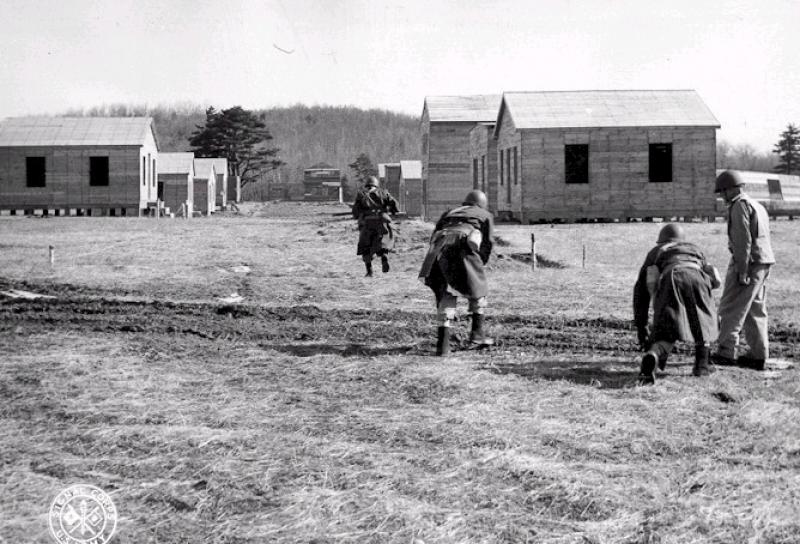
MOUT Training, Ft. Devens, MA, 1973
Taken From Just a Few Lines: The Memoirs of Keith L. Winchenbach
By Keith L. Winchenbach was born in Rockland, Maine on July 13, 1923
Submitted by Jessica Winchenbach from handwritten notes from her grandfather, Keith L. Winchenbach. All chapters have been edited and proofed by Jessica Winchenbach.
I had mixed feelings about going to war. I suppose that I wasn’t truly sure what to expect. I had never been away from home for any extended period of time, so I was anxious of the notion. Regardless, I left Waldoboro on November 4, 1943, one day before Mother’s birthday. I was twenty years old, I had $ 7200 in the bank, and I was on my way to seeing the world.
Training Days
I went to Fort Devens, Massachusetts on November 4, 1943. This was where I and the other soldiers stayed until being sent into serious training. I remember vividly how cold it was there. Waiting in line for breakfast in freezing weather was not exactly something that I looked forward to. Initially, while in Fort Devens, the work hours were long, or they tried to make them so. There was only so many floors, windows and dishes to wash, and the superior officers did their best at keeping us busy. We rose at about 5:00 am and began working, usually until about 6:00 pm at night. There were about 500 men in my company, and 2000 total in the camp. The barracks went on and on for miles on the base.
We did not undergo very much training in Fort Devens, as I had initially prepared myself for. We did a little marching, but most of the time we worked. I remember having to wash dishes for 5000 men at one point while I was there. I learned to fuss over everything. I had to make my bed in the morning, and the mess hall floor had to be swept and washed after every meal, three times a day. The tables in the hall had to be set up in perfect rows. The salt, pepper and sugar had to be filled after each meal and lined on the table precisely. All windows had to be streak free and crystal clean. I suppose that Sunday was my favorite day because it was our only day off. It wasn’t that I minded the work; work I was accustomed to from my upbringing, however, it was nice to have the freedom to do what I wanted to do, which I lacked while in the Army.
By the end of November we had completed our “processing,” and were to begin our regular training. Some new rifles were shipped in, and put in the barracks, which we would learn to use right off. The Fort actually trained with live ammunition the whole time that we were there. I decided that I wanted to ride in one of the new 30 ton tanks on the base, either as a driver or a gunner. During the processing period, they put us through a series of clerical and typing tests, both of which I did very well on, I was told. I thought that I would be going to clerical school after only ten weeks of basic training, in order to be a clerk. However, it didn’t exactly work out that way.
I remember getting lectured many times while we were at Devens. The Colonel told us how praised Fort Devens was for producing quality soldiers into the Armored Division. It was one of the best Forts in the world, and General Eisenhower had praised Fort Devens for their magnificent Armored division trained there.
Honestly, my stay at Fort Devens was quite boring. We were merely working and waiting. Waiting to hear of where we would be shipped off to. I was extremely bored and wanted to be assigned so that there would be some change! My mother wrote to me nearly every day, and hearing of the news back home was always a good way to pass the time, but still I wanted to be shipped out. Thinking back, I suppose that I was the most content of the boys I was with in the camp. Everyone else truly hated it, and granted it was boring, but I could see nothing too wrong with that.
* * *
I was then sent to Fort Knox, Kentucky in December of 1943 to do my basic training, which was in armor, on the tanks that so interested me. The weather in Fort Knox was indeed a cut above that at Fort Devens. I could walk around in the day time in just my shirt sleeves. It did get cool at night, but I was not complaining, after freezing in Massachusetts.
I remember when they first took us out on the range, where they practice and train the armored divisions. They sat us down on a slope and proceeded to show and explain all of the arsenal to us. First they showed us a Jeep, a tiny scout car with a machine gun mounted on it. Next came a 2.5 ton, six wheel truck, followed by a 16 ton tank. This tank came roaring down the opposite hill straight at us, and then turned around, stirring up an awful cloud of dust, which is one of the things that I had to eat when driving the tank! This tank had light armor and a cannon on the front. Its main feature was speed.
The last vehicle they showed us was 64,000 pound tank, which is more heavily armored, and can carry a crew of five men. In order to put this machine out of action, a large bomb would have to hit it directly. The personnel at Fort Knox told us that this type of tank was used in Africa, and claimed to be the best in the world for its size, even by the Germans themselves. The British also praised it, and it truly did look tough. This tank cost over $100,000 to create! If I remember correctly, the armor is about one and a half inches thick. This was to be the type of tank that I would learn to work within.
My training was in thirty ton Sherman tanks. After learning basic rifle and machine gun skills, I was trained in all aspects of tank operation, gunner, driver, observer, and commander. They told us that if we could drive a tank through the Kentucky mud, then we could drive one anywhere in the world, and after trying it, I decided that they were right. I was chosen to be a lance corporal because of my high score on the aptitude tests in Fort Devens. I was called out of my group, with a few other rookies, and told that we qualified for the OCS, Officers Candidate School. However, the war progressively needed more and more men to fight, and my chance to go to OCS dwindled in the call for more men.
At Fort Knox, we were divided into squads of eight men, and assigned a leader. I was chosen to be the leader of my squad, the sixth squad. This meant that I had to be sure that my squad was all present, and that their beds were made correctly. Later on, I would have to inspect the work of my squad mates. I realized that this place meant business when I saw tanks rushing down the road followed by loads of trucks and jeeps. Endless hours were spent in Fort Knox firing our rifles. I remember my ears ringing for hours afterward, and being practically deaf!
I received my first pay check in the middle of December 1943. Actually, it wasn’t a check at all, but cash! I was amazed at the way the other soldiers used their money. They acted as if it were merely scrap paper! They got out the cards, and the tables and started playing poker. They played for long hours, often half way into the night. One fellow had $60 that night, and by the next morning, he had only five dollars to his name! Not just a few soldiers played, but practically the whole barracks! They could never get me in on the game, because I had heard what Father had said about gambling, and I was beginning to believe him. He said that you would always loose out in the end. The guys usually did well for a time, but then first thing they knew they would be broke!
Before joining the Army, I had never seen a place filled with so much rampant sickness. Out of our 230 men, there are at least 20 men or more in the hospital sick. Some came out each day, and more entered the hospital each day. I remember that my buddy was a squad leader as well, and just before Christmas he had six of his eight men in the hospital for most of the week. I kept kidding him about how big his squad was and what a bunch of cripples were in it!
By mid December of 1943, at Fort Knox, I was advised not to write to anyone about our training there. Our commanding officer told us that the Army did not want the enemy to get a hold of the training tactics that they were using. I remember seeing a picture on it called “Military Information”. It stated that if an enemy agent got hold of three weeks of detailed letters, they would have a complete record of all of the training up to that period. I found this sort of silly. Keeping troop movements, and military equipment detail secret seemed reasonable, but the details of a day in training shouldn’t be such a great concern.
It began to get cold in Fort Knox just before Christmas time. Being in Kentucky, I was not sure that it would get cold at all. However, the cold at Fort Knox is such a damp cold that it cuts right through you. I was more used to the winters in Maine when it was 20 degrees below zero, instead of 5 degrees above in Kentucky. Although, I wasn’t crawling around on the ground in Maine, as I was at Fort Knox! At points, I was so cold my teeth ached, as if they were frozen!
I spent my first Christmas away from my family and South Waldoboro in 1943. I wished that I had been home, however, the holiday wasn’t so terribly awful as I had expected. They kept us so busy that it was hard to be homesick! I planned on going to Louisville over the Christmas weekend, but was on guard duty the day before Christmas Eve, and decided that the city would be too busy. I turned out to be right. Many guys reported that it took about three hours to get a bus down there, and rooms were hard to come by as well. I had a nice Christmas, with a free meal and lodging in the barracks. I got to catch up on some sleep over the weekend too, which was nice.
A Christmas party was held for us soldiers on the base which was nice. There were cakes, cookies and candy. We had a nice meal, and then we were each given a gift. I received a tablet and a pack of cigarettes. The tablet came in handy for writing letters, and I made a profit by selling the cigarettes. I was impressed with the party. It must have been expensive to feed all of us and give us each a present. I was very thankful for that.
At Fort Knox, we were trained to use what seemed like every gun that the Army had in its arsenal. At first, I was not too comfortable shooting, and did quite poorly. Gradually, I got better, and different guns always yielded different scores from me. I began not to mind the guns anymore, as I suppose that I just got used to them. I remember making expert with the machine guns, but they gave no medals for that achievement.
Marches and hikes were the highlight of my training at Fort Knox. We built up to hiking at least ten miles a day, usually twenty miles, to the destination and back. On our hikes and marches through the red Kentucky mud, which suctions your feet to the ground and makes things highly difficult, we carried about 30 pounds of gear. I suppose that lugging grain most of my life had prepared me for these arduous hikes, because they didn’t bother me as much as they did many others.
By early January of 1943, my squad was growing small. Some of the fellows went to the hospital and missed so much training that they had to join another company. Another one of my guys was discharged, and so I was left with about five men in my company. By this time, the cold had ceased, and the weather was more agreeable. However, I wasn’t sure if the cold or the mud was better.
The infiltration course, in which you have to crawl under barbed wire, through the mud, under live machine gun fire, was a messy training session. I could hear the bullets whizzing by my head, as I huddled my head low and crawled swiftly under the barbs. They also made us dig a fox hole, get in, and have a tank drive over the hole. I remember the Lieutenant saying that there was nothing to get excited about as long as we wore our steel helmets, and then he laughed. This was a muddy expedition. Getting my boots and clothes clean after these exercises was difficult, and at times, I remember being nostalgic of the colder weather. As for our guns, you couldn’t tell if they were guns, or sticks rolled in mud!
I was also put through vehicle training at Fort Knox. I remember being out on the driving range every day. We ate out there and everything. We only came back to the base to sleep. I drove the 2.5 ton, 10 wheel truck, the half tract personnel carrier, and the light tank, which weighs 16 tons. We all liked to drive the tanks. They would make us drive it into deep ditches, so deep that I thought that I would never get back out! Kentucky is not exactly flat, and so I received plenty of hill experience, not to mention the density and proportion of mud I had to steam through.
The week after that, I got to drive the 32 ton Sherman tank. These tanks were “high tech”, and equipped with radios, which you could communicate through while traveling along! The General Sherman tanks do not move as fast as the light tanks, but carry five men, and have more armor, and a 75 mm cannon. We trained on Sherman’s for about two weeks, so that we would know them inside and out, which we did by the time we finished that exercise. When we finished for the night, we had to clean the tanks. By the time that we were done, we all looked like garage men, covered in mud and grease from the gargantuan tank. The tanks had to be inspected, and needed to be spotless and greased perfectly.
In order to grease the tanks, we had to use hand pump grease guns. It usually took at least 12 to 20 full guns to properly grease the tanks. We also had to carry the gasoline to the tanks and fill up their tanks. During the day, we usually burned about 75 gallons of gasoline, so lugging gas in five gallon cans back and forth took us quite a while. After we used the tanks, there was always the matter of cleaning them, which took approximately two hours. Depending on how late we were finished training for the day, we could be up quite late cleaning and greasing the tanks.
These tanks sure could go through tough places. One week, we took them through some thick woods, and barreled over anything and everything in our way. We hit trees that were fifteen inches thick, and over the trees fell, without even damaging the tank! After the tank knocks a tree over, it climbs right over it and keeps on going. It was quite a sight to see them plow such a path through thick woods.
At the end of January 1944, all of the Cadre, the men who were training us, were anxious and excited about a new law which had just gone through, and was taking all soldiers who had been training men for one year or more over seas. They were to leave in June of that year, and we were to be left to new Cadre. Two thirds of the men inducted then were supposed to go into the Navy. By the sound of the newspapers, I knew that a lot of us would be going overseas. They said that they were going to double the 2.5 million men already over there. I had eight more weeks at Fort Knox when this was announced. I knew that after Basic Training I would probably be going across as well, but I looked forward to the 11 to 15 days of leave that I would get prior to my departure.
After the training on driving various tanks, we began a two week session of gunnery school. This involved driving the tanks, and firing the big guns from them. We also learned how to operate all of the large arsenal that we were not yet acquainted with. I felt as if all that we did, for the most part was fire guns. I didn’t know that there were so many different kinds of guns in the world! At the rate that we were going, we would soon be able to fire them in our sleep. Firing one of these tank guns, is apparently equivalent to firing a torpedo from a submarine. We were taught to use the periscopes to see out of the tank and fire the 75 mm. The tanks are also equipped with a telescope for better viewing targets. It is very hard to judge the correct range of a moving target through either the periscope or telescope! Parallel to the 75 mm, on the Sherman tanks, there was a 30 caliber machine gun. Both of these guns fire from the same place. The 30 caliber was much less powerful, but still had an extraordinary kick behind it.
While in training one day, we were in an M30 Sherman tank. We were instructed to fire at an old truck about eight miles away. If you were an observer, you had to stand outside of the tank, and use field glasses. It usually took about seven or eight rounds to take out the target. There were no ear plugs, so none of us were hearing too well during or after this training session. There were two guns in the tank; a 30 caliber machine gun, and a 75 mm gun. The firing button for the 75 mm was right next to the 30 caliber gun on the floor. The gunman fired the 30 caliber and nothing happened. I told him that he had his foot on the wrong button. He changed buttons, and the big gun went off and blew a 3 to 4 foot hole in the earth 300 feet away from the tank. Needless to say, we heard about this as soon as we were outside the tank. A lot of men were observing, and not too happy with our poor display of shooting abilities.
While being prepped about the 75 mm, we were told that every time that that gun was fired it cost $18.00. Our training allowed for each of us to fire 25 to 35 times. In other words, each one of us soldiers fired approximately $600 dollars worth of ammunition! At this point in my training, I realized why Americans had to pay income taxes, and why the government sold bonds! Simply to pay for our training, which was amply expensive. When we did finally get to fire the 75 mm, 100 of us fired about $35,000 worth of bullets! I remember that the noise was outrageous, and that I had trouble hearing for a long time after that. When my company had finished the Gunnery schooling, the lieutenant in charge said that we were the best class that had gone through up to that point.
Although the division that I had chosen was tanks, they told us that by the end of basic training we would have had infantry training, artillery training, as well as the tank training. The last two weeks of basic training were to be battle training. Under this training we would have to drive our own tanks, in conditions as similar to battle as possible.
By the twelfth week of our training, our weekend passes were taken away from us, and we had to work all day Saturdays, and half a day on Sundays. For me, this meant merely giving up going to the pictures quite as much, and of course getting less sleep. I was only upset that I would have even less time to respond to the many letters that I received.
Battle training began after we were finished with the guns. We had to sleep in tents, and eat rations. I was chosen to be a tank commander, which meant that I was in charge of a tank and five men. We were given a map and a mission, which we had three days, and three nights to complete. Then of course we had to find our way back to where we started from. Before departing, we were told that many tanks had trouble finding their way back to the starting point.
Battle training was what I imagined the boys overseas were becoming accustomed to. We worked all day, from 5 AM to 7 PM, driving the tanks, and trying to complete our missions. We slept in tents; six men in each one. Our rations included two cans of food for each meal. For dinner, one can contained some kind of stew or hash, and the other had a sugary beverage, and some biscuits, which we promptly renamed “dog biscuits” for their likeness. These were the first rations that we received in battle training, and were labeled “C” rations. “D” rations contained a chocolate bar so sweet that it took 30 minutes to eat, and even made some guys sick.
Luckily for my group, we had one guy with us who had so much extra food with him, it was like he was running a grocery store! He had so much food that he couldn’t fit it all into his barracks bag, so all of us had to carry some food for him. Apparently, before joining the Army, he did run a grocery store. He must have kept his stock when he left home and brought it with him, judging from his supplies.
After some harsh Kentucky weather during our battle training, most of my crew wasn’t sure that we would make it. Consistently miserable weather made for hard trekking in the tanks, and even harder camping! I suppose that the fifteen weeks previous to this training were supposed to have gotten us prepared for the worst, but I never imagined how horrid the worst really could be. The missions and problems that they gave to us were difficult, and required much hiking, navigating and driving. A couple of times, we went for what seemed like days without sleeping, but really it was only about two days usually. At any rate, my whole crew made it through the battle training. We were all relieved to get back to camp again.
Basic training was suddenly over for my company. We didn’t do much after we were through, besides turn in all of our company equipment. It was sort of crazy after battle training. Everyone was running around trying to get everything returned properly. None of the guys knew what would happen to them next, including myself. I was indeed glad that training was over, and was itching for a change of scenery. I definitely would not miss the red Kentucky mud at all! I was not sure whether I would get a furlow to go home, before I was shipped overseas, or if I would be plopped in another fort in the U.S.
I was actually selected to stay at Fort Knox and join the Cadre, which trains the incoming soldiers. However, shortly after being thus assigned, this assignment was canceled, and I was again in the same boat as all the other guys. All of us ended up laying around the barracks for about a week, less for some, before we were shipped off. By the beginning of April, I was left in the barracks with only eight other men. It got quite boring. Everyday, new orders would come in, and we would be informed that we were going this place or that, but these changed daily. Finally, the Army decided that I should go to Fort Ord, California. This decision was fine by me. I was in need of some decent weather after being in rainy, muddy Kentucky for so long! I would be stationed at Fort Ord in order to replace a wounded or killed American soldier.
In the beginning of April, 1944, I was sent home on a delayed route before going to California’s Fort Ord. I was at home for about a week, and this was the only time during my twenty-seven months in service that I was able to visit at home. It was nice to see my family after such a long separation, the first that I had ever been away from them.
The trip from Maine to San Francisco took four days on a regular train car. There was no bed, just seats to ride in for the entire 100 hour trip. On my train, across the isle, there was a “hillbilly” family, traveling with their daughter and a small baby. I am quite sure that that baby cried the entire trip. The family had come from the mountains of Virginia. They had packed a lunch to last them four days. It consisted of ham and some bread and cheese. The father of the family was chewing tobacco, and despite the ‘No Spitting’ sign over his head, he would let go on the floor every once in a while. I’m sure that he wasn’t being ignorant. He simply couldn’t read.
Every train that I rode on, from Maine to California, was packed full of people. Most of them were soldiers, and somehow, I managed to hook up with another fellow from Knox, who was going to Ord as well. This fellow and I traveled almost the entire trip together, and bunked together when we landed in sunny California. We stayed in a hotel, until we were transferred to the barracks with all of the other soldiers.
It was a long trip. I remember seeing Salt Lake in Utah. The lake was so salty that the water appeared thick and white. I remember Nebraska, where you could see straight out for twenty miles. When we went through the mountains of New Mexico, just before reaching California, they were covered in snow. Seemingly only minutes later, we looked on to the green valleys of California. There were hundreds of acres of vegetables. They called this the ‘Salad Bowl’ of the world.
When I finally reached California, I was relieved to lay in a bed. The day after I arrived, the Army began to “process” us. They did physical examinations, IQ tests, and interviews. They informed me that I would still be in the armored command on tanks, which I was glad of. I remember that the corporal who interviewed me told me that I scored better on the I.Q. test than the majority of college graduates. He informed me that usually replacements, like myself, found a spot in some division in about a week to thirty days.
On arrival at the new camp, I discovered that the food was much better in California. I had chicken for dinner, and it actually tasted like chicken! Which is more than I could have said about the grub at Knox. I was informed that the following week, we would begin training review. The guys who had already started it said that it was pretty tough, but I rested assured that there wouldn’t be any red Kentucky mud, which was a plus.
At first, I thought that California was a great place to live. The climate was nice, and usually stayed about the same all year round. Everything was green, and even the barracks had flowers planted around them. It was almost unreal, more like a picture than the real thing. From the barracks, we could see the Pacific Ocean, which was nice after being land locked in Kentucky for so long. The earth in California was not muddy like in Kentucky, but sandy, almost like a desert. In the afternoons, the wind always picked up from the sea, and most of the trees there were leaning over from the constant wind. They looked interesting and lopsided.
The fellows at Fort Ord were all homesick. I was not really homesick, in fact, I wasn’t sure what it really meant to be homesick, although, I would rather have been at home. However, as soon as Monday came along, and we were put on details, mostly cleaning, I think we all forgot about home, for lack of time to think.
The details we were assigned were mostly cleaning jobs. I thought that they were fussy about cleaning at Knox, but it turns out that Knox was dirty in comparison to Fort Ord. I could have eaten off of the floor in the barracks at Ord! We completed our details in about two days, and then we began the training review. It was supposed to get progressively tougher each day, but I couldn’t imagine that it would be any worse than our basic training. They told us that this training would only last about thirteen days, so I wasn’t sure how hard it could be.
After starting the training review, I realized that it could indeed be harder than basic. We had to do an hour of physical exercises a day, which, initially made all of us lame. I knew that we would get used to it though. We did many overnight treks, and camped out. Our packs were stuffed full, and heavy as anything we ‘d carried yet. I guess that our packs weighed about fifty pounds or more. These outings usually consisted of us carrying our packs, and rifles for about six miles, sometimes more, for a total of about an hour and a half, without resting. Then we camped, cleaned ourselves up, and rested. The next day we would hike back. We went on these excursions almost everyday of the training review. At some point during the training, I got Poison Oak, which festered all over the place there. It was all over and around the barracks, and there were signs telling us to steer clear of it, but they still made us creep and crawl through it, and sometimes even sleep in it. At one point, the majority of the camp was covered in it.
Everyday, men were being shipped out overseas, as replacements. I understood that the Army didn’t have much use for tanks against the Japanese, but I was hoping to stay in the Armored Company. However, in the beginning of May, we were told that most of us in the Artillery, Calvary and Armored Forces would probably go into the Infantry division, as they couldn’t use much of the mechanized forces of the Army in the jungles of the South Pacific.
I waited patiently, and did the work that was required of me. Much of which was cleaning the barracks. I remember the first time that I saw some German prisoners who were cleaning up around the barracks. Another time, I saw some German prisoners unloading eggs from a truck. They were speaking German, and it sounded truly queer. There were also men who had been overseas, and came back, “rejects” they were called.
Part of our training was to become accustomed to the weapons and uniforms of the Japanese. When they showed us the weapons, they looked so odd. Cheap looking is how I would describe them. However, we were told that many of their weapons were very accurate, despite their awkwardness, which I could later agree with from experience.
While at Ord, I noticed how drawn all of the fellows were to beer, cigarettes and girls. It seemed like most of them didn’t give a damn about anyone or anything. I think that I was the only one in the barracks who didn't drink or smoke. And everyone gambled, in a more frenzied way than I saw in Knox. I remember wondering how people like this, who care only for women, gambling, and drink, could win a war. But then I reassured myself that these guys knew that they wouldn’t be in the States very long, and were determined to raise Cane while they were still there. At times, I remember wishing that they would just send us across, so that everyone would finally sober up long enough to know what we were up against. I wanted to leave as soon as possible, so that I could do my part to win that war, and get back home again.
After we had finished the training review, we were told that there would be two hikes each week, and two night problems. There was a 25 mile hike every Wednesday night, and a twelve mile hike when we could fit it in. We also did a couple of 52 mile hikes, twenty six miles each way, that I remember. We hiked up and down hills and through the woods to get to our camp site. It was right on the Pacific Ocean. We set up camp, and went straight to bed, as one might imagine after hiking for six hours. The next day we fired anti- aircraft guns all day. Around six o’clock we started back to the barracks, and arrived at about midnight, all of us having sore feet. The next day, most of us were limping around the camp with sore feet and legs.
I definitely learned to march and hike while at Fort Ord. On average, I think that we marched at least 75 miles a week, and I know that some weeks we did over 100 miles! They liked to keep our feet in action, probably so that our minds weren’t in action. I managed to make it through all of our hikes, but there were quite a few guys who didn’t. I suppose that we hiked because they were lacking in things for us to do. There are only so many barracks to clean, potatoes to peel and things to paint.
After seven weeks in Fort Ord, I was one of the only ones left from my original group. There were about ten other guys that had gone through training review with me, but other than that, all of the guys were new to the camp. I was placed almost permanently on K.P. duty, and got quite used to the hard labor and long hours. Besides, many times, I missed the hikes that our company went on, or only had to walk half of the way, and got to ride the rest of the way. I didn’t mind it so much, I got to eat all that I wanted while I was on K.P., but I was getting sort of bored at Ord. I became a veteran of the camp. I suppose that I was lucky not to be shipped off, even if I didn’t like the fooling around that went on at Ord.
In mid July of 1944, myself and many others were alerted that we would be shipping out very soon. Despite the many previous alerts, this one seemed more real. We underwent a clothing check, and they gave us all kinds of mosquito equipment. I decided from the looks of our clothes, and equipment that we were going to the South Pacific. The six or seven men that I had gone through basic training with were also alerted, so I was comforted by the idea that I had some chums with me. My only disappointment was that we weren’t allowed to take any writing materials with us, so I would not be able to correspond with anyone back home for a while.
I left the states from San Francisco, at the end of July, 1944. I traveled on an old ship named The S.S. George Washington, built in the early 1900’s. The ship was 42 years old, and quite a ship! It had been used in the last war to carry troops overseas as well. This ship was credited with taking the largest cargo load out of San Francisco Harbor. It was very rusty and primitive to say the least.
We went under the Golden Gate Bridge on our way out of the harbor, which was amazing! There were 2,600 troops on the boat, more than dwelled in my home town. However, because the galley could only feed two shifts a day, we had to forgo lunch. For dinner, they gave us a sandwich and an apple, and marked our helmets so we couldn’t go through the line again. Some soldiers were so hungry they were stealing and eating raw onions.
We crossed the equator on this trip, and had a big celebration. We were initiated as “Trusty Shell Backs” of Davy Jones and Neptunus Rex. Ha,ha! We also crossed the International Date Line, where we went to sleep on a Wednesday night and woke up on a Friday morning. Thursday, August 3, 1944, was the only day that I didn’t live, technically speaking. We spent most of our time playing cards, watching boxing matches or staring into the emerald, blue abyss of the sea.
I was at sea for 27 days. For two weeks of that trip, I didn’t see a speck of land. When we finally did see land, it didn’t really matter that it was jungle, and not home! The boat zig-zagged back and forth the whole way. And every morning and night, everyone had to be on deck with life belt, and canteen, ready to evacuate ship in case of an attack. If there was an attack, there wasn’t much hope, because there was no land for miles, and we were the only ship in the convoy.
We got into a bad storm at one point along the journey. The waves crashed up over the deck. The boat was so old that the latrine was on the main deck, and when the seas were rough, it would cause the debris in the latrine to spill out onto the deck. During the storm one night, at about midnight, a female voice came over the mike, calling all men to the deck. Come to find out, a bunch of nurses and the ship’s crew were having a beer party, and called us on deck for no reason.
This atrocious storm managed to blow us 500 miles off course, in the direction of the South Pole. We were in the harbor of New Caledonia, but did not get to go ashore. We finally landed in Papua, New Guinea a few days later. Because of the terrain in the Philippines, there was no need for tank men. We all ended up in infantry divisions, or calvary divisions. I went into the 24th Infantry division, 21st Regiment, 1st Battalion, Anti-Tank Platoon Headquarters Company. My number was 31,399,438.
- Log in to post comments