
2003 - The story you are about to read comes from a very dear friend of mine, Dr. Jim Kirby. I had the opportunity to meet Dr. Kirby in a WWII chat room on AOL called WW2 Vets and Friends, which James Vernere and Dr. Kirby co founded. This is a wonderful chat room full of veterans and friends. The room meets everyday at 1 p.m. and 7 p.m. Est. please join us and share your stories.—Dr. Zoë Simmons
Dentists Recount Okinawa
By: Daniel McCann
Provided by: Dr. Jim Kirby
He spoke slowly. His voice on the telephone sounded gravelly and strained. He never identified himself. And he never paused to allow his listener to respond:
“I saw the notice in the June 19 ADA news for Okinawa vets. Well, I’m one. What is it you want to know? I have to tell you first that it was one of the worst experiences in my life. It was terrible, terrible time. In fact, I really don’t want to talk about it. Goodbye.”
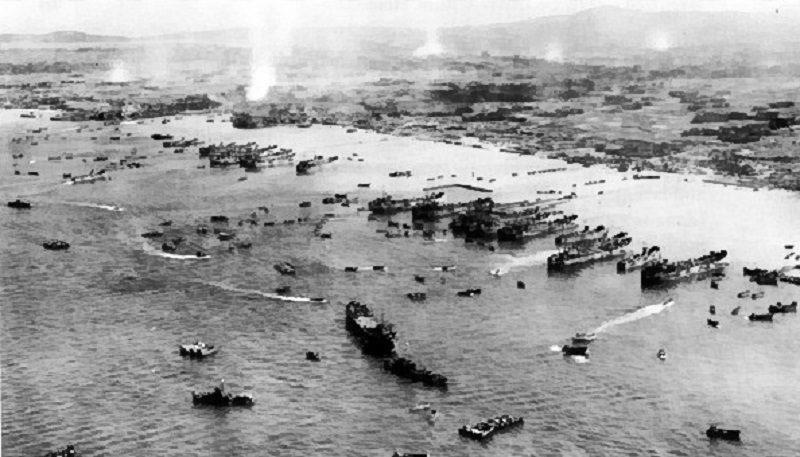
On Easter Sunday, April 1, April Fools’ Day, 1945, an assault force of 180,000 American troops, aboard 1,300 battleships, destroyers, aircraft carriers, cargo ships and assorted landing craft, lay in wait about a mile off Okinawa Island.
At 2 a.m. many of them were trying to sleep. In another hour, Dr. Williams Ditto, a 2nd Lt. in the U.S. Marines, would be awakened for the traditional pre-invasion “blitz breakfast” of steak and eggs.
Along with 50,000 other Marine and Army troops, Dr. Ditto was slated for the first day’s assault of Okinawa.
For the U.S. High Command, the battle marked the penultimate step in a campaign destined to take the war to Japan’s doorstep.
They called it island hopping. Earlier, Guadalcanal, Tarawa, Guam, Saipan, Iwo Jima and others had all fallen to American forces.
Next was Okinawa, and victory there was key. Just 380 miles from Japan, the island would serve as the springboard for the Allied invasion of the Japanese homeland, set for November 1945.
At 4 a.m. Vice Adm. Richmond Kelly Turner gave the order to begin the attack.
Shortly afterwards, the bombardment began. For the next three hours, Navy ships and aircraft shelled, bombed and strafed the island in preparation for the landing.
One observer recalls, “The criss-crossing of shells and rockets looked like an illuminated net in the sky.”
It was the heaviest pre-invasion bombardment of the war. More than 100,00 rounds exploded around the eight-mile stretch of beach near the town on Hagushi, where the troops would go ashore.
Around 8 a.m., under a cloudless sky, the landing craft headed toward the island. Despite the shelling, U.S. soldiers were braced for a furious battle on the beach. “ We heard about the great loss of life at Iwo Jima ( a month and a half earlier),” says Dr. Ditto, “and we knew that in Okinawa, right up there at Tokyo’s back door, we could expect them to throw everything they had at us.”
One Marine was overheard saying to another, “My theory is to keep moving, don’t stop moving.”
As his landing craft approached Okinawa, Dr. Ditto, in charge of a mortar platoon, recalls, “wondering whether I could do my job. Could I do it right under all the pressure? And could I take care of my men and get them under cover as soon as we hit the beach? But as it turned out, all of those were lost worries.”
War correspondent Ernie Pyle, newly arrived in the South Pacific after spending two and half years with American troops in Europe, was with the seventh wave of soldiers to go ashore that morning.
“I had dreaded the sight of the beach littered with mangled bodies,” he wrote later. “My first look up and down the beach was a reluctant one. And then like a man in the movies who looks and looks away and suddenly looks back unbelieving, I realized there were no bodies anywhere—and no wounded. What a wonderful feeling!
Unlike earlier Japanese commanders defending islands in the South Pacific, Lt. General Mitsuru Ushijima had decided not to contest the beaches.
His defense, for the most part, would concentrate on the southern end of the island.
About 80 miles long and ranging from four to 20 miles wide, Okinawa is a varied landscape. From north to south, the thick forests and mountainous terrain gradually give way to rich, flatter land, punctuated with coral ridges and ravines.
In those ridges, a cave system with some 60 miles of tunnels would provide concealment for Japanese forces and heavy artillery.
In addition, the relatively new tactic of using kamikazes—piloted suicide planes carrying high explosives—would be employed in full force and target, primarily, the U.S. Navy.
Gen. Ushijima, with an army of 110,000 soldiers and Okinawa conscripts, had settled on a strategy of attrition. He would rely on the kamikazes to batter the U.S. Navy and then wear down the assault troops by forcing then to fight a very slow, protracted struggle. Out numbered and overpowered, Gen. Ushijima intended, at the minimum, to inflict heavy losses on the Americans.
Col. Hiromichi Yahara, a senior staff officer at Okinawa, was the architect of the Japanese strategy. Earlier this year his 1973 book, “The Battle for Okinawa,” was published in English. In it, Col. Yahara recalls the scene April 1 as Japanese senior officers watched the American landings.
The commanders of Japan’s 32nd Army,” he writes, “are standing on the crest of Mt. Shuri near the southern end of Okinawa’s main island, and quietly observing. The group simply gazes out over the enemy’s frantic deployment, some of the officers joking, a few casually lighting cigarettes. How could this be? For months now the Japanese army has been building its strongest fortifications on the heights of Mt. Shuri and its adjacent hills.
“Here they will lure the American forces and confound them. Hence their air of nonchalance. The battle is now progressing exactly as expected. All the Japanese command needs to do is to await the completion of the enemy’s landing…and watch them finally head southward.”
With little opposition on the beaches, U.S. forces made the quick progress inland. By the end of the first day, Dr. Ditto’s platoon had advanced about a mile—a distance they originally estimated would take four days to achieve.
By April 3, U.S. forces reached the east coast, effectively cutting the island in half. The next day the Marines set out to secure the northern part of the island and the Army turned south.
On April 6, the Japanese unleashed their aerial offensive against the American fleet. Dr. Joe Kanter a lieutenant in the U.S. Navy, was abroad the U.S.S. Vega, a cargo ship.
“We had what were called destroyer picket duty ships, about 50 miles out from Okinawa, and they had radar to warn ships in the harbor when enemy aircraft were approaching,” says Dr. Kanter.
“Well, the kamikazes usually hit the picket boats first. But when they got past them, they’d come in toward us low and pick out targets to dive on. At night, they would follow our guns’ tracer fire down and dive straight into the ships.”
More than 700 Japanese aircraft, including 300 kamikazes, attacked the U.S. fleet between April 6-7.
The toll was heavy: six ships sunk and 27 badly damaged.
Dr. Ray James, a Navy fighter pilot aboard the U.S.S. Intrepid aircraft carrier, routinely flew missions to intercept enemy planes.
On one such mission, he recalls being alerted of Japanese planes nearby, traveling at an altitude of 8 to 10,000 feet.
“Dog fighting is pretty much like wrestling,” he says. “It’s to your advantage to be on top. So we planned to encounter the ‘bogies,’ as we called them, at 10 or 11,000 feet.” Dr. James and the other three Corsair pilots searched the sky for the enemy planes.
“We were looking down to see where they were. Then all of a sudden we realized there were about eight of the, Japanese Zeros, and they were well above us, at about 15,000 feet.”
The Japanese pilots began a steep descent toward the American planes. They approached from behind, firing on the Corsairs. Dr. James saw that two of his wing guns had been destroyed.
“But they did something foolish,” he continues. “Their descent was so steep that by the time they recovered we had the advantage.”
“I chased one from an altitude of 12,000 feet down to about 500 feet before I finally shot him down,” Dr. James says. “I recall watching the film (taken by a camera inside the cockpit), and when I finally shot him the insignia on his plane, the Rising Sun symbol, practically covered the entire screen. And that’s much too close for comfort. I never should have been that close. But at that point you get pretty keyed up.”
Five of the eight Japanese planes were shot down. “The fact that all of the Corsair pilots made it out of there was very, very fortunate,” says Dr. James. “Because there’s a lot to surviving in war that’s luck, over and above skill.”
On April 18, the Marines declared the northern sector of Okinawa secure.
That same day, correspondent Ernie Pyle was shot and killed by a sniper on the island of Ie Shima. Pyle’s straightforward and conversational newspaper columns celebrated the common soldier, the unusual heroism displayed daily by young men who just a year or two earlier were farmhands or gas station attendants.
The soldiers with him buried Pyle in a wooden casket and erected a sign above the grave: “At this spot the 77th Infantry Division lost a buddy, Ernie Pyle.”
In late April, Marine units headed south to assist the Army.
Dr. James Kirby, a Private First Class in the Army’s 184th Infantry, served as a forward intelligence observer.
He would look for the nearest highpoint, a hill, for example, and from there try to observe enemy movements.
On May 28, Dr. Kirby was with G Company, setting up a command post near the Chinen Peninsula. At about 9:30 p.m., Dr. Kirby and another soldier were ordered to set up advance post to bar a possible counterattack.
They found a shell hole about 30 yards up. An hour later four other soldiers joined them, and they began to alternate guard duty.
“I and another soldier rolled up on the backside of the hole and went to sleep,” says Dr. Kirby. “Then all of a sudden—it must have been about 4 a.m.—the group in the hole started firing.
“I rolled into the hole, and as I did, an enemy light machine gun hit three of the soldiers there. I don’t know what happened to the other one, but now it was just a new replacement and myself.”
Dr. Kirby heard Japanese soldiers talking in low tones as they approached his position. “I realized they were around us,” he continues. “I then threw a total of eight hand grenades out there.”
Everything was still for maybe 20 minutes. “Then small arm fire started hitting a poncho lying at the edge of the hole.”
Two enemy soldiers about five yards away started to rise and move toward Dr. Kirby’s hole. “I raised up and started firing at one of them. I got off maybe three rounds, and then I don’t know what happened.”
“There was a large flash of light. I was dazed. I reached down to get my rifle and picked up nothing but the barrel and sling. I had been hit in my left arm and shoulder, and another bullet hit the magazine of my rifle and blew it in two.”
Any remaining Japanese soldiers had apparently retreated. Dr. Kirby and the other soldier with him made their way back to the American front line.
Throughout the month of May, U.S troops fought practically cave to cave to dislodge Japanese soldiers. With each U.S. advance, the Japanese would fall back and set up another defensive line.
But the end was in sight. On June 11, Lt. Gen. Simon Bolivar Buckner, commander of the U.S. land operations, sent Gem. Ushijima a note asking for his surrender. The Japanese leader refused.
Eleven days later, U.S. troops raised the American flag on Okinawa. The same day, Gen. Ushijima committed suicide.
The victory had come at a high cost: 36,000 Americans were wounded at Okinawa and 12, 500 died, including Gen. Buckner, killed by a sniper on June 18.
About 100,000 Japanese died and nearly 10,000 captured.
Thirty-six U.S. ships had been sunk and 378 damaged.
The Japanese lost 3,000 planes—about 1,900 of them kamikazes—and 16 ships.
From the end of June into August troops continued to arrive in Okinawa to prepare for the invasion of Japan.
Then on August 6, 2:45 a.m., three U.S. B-29 bombers took off from South Pacific island of Tinian, bound for Hiroshima.
Published U. S. Legacies September 2003
- Log in to post comments