
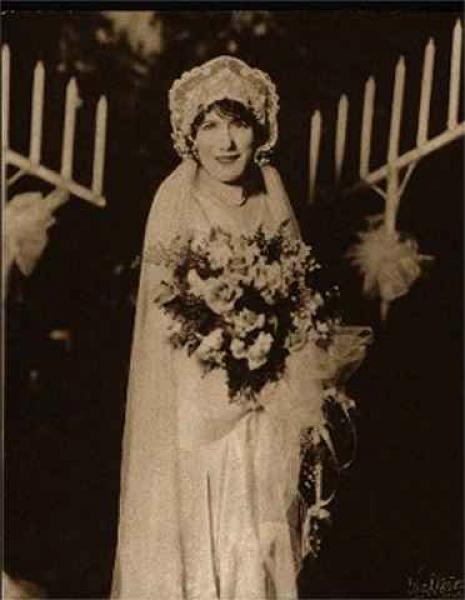
Wedding picture of Florence Hillinger circa 1928
By Katherine A. Rubin
Elk Grove, CA
"Nobody could ever agree on my birthdate, so I just picked one," my grandmother always told us. In turn-of-the-century Seattle, fires were frequent and all records of her birth were destroyed. She chose June 14, Flag Day, as a tribute to the adopted country of her parents, who had fled Soviet persecution a few short years before. Her parents Samuel and Bluma Shapiro met after they originally settled in Devil's Lake, South Dakota, but moved on to Seattle when farming failed to support them.
Florence was one of the five surviving children born to Sam and Bluma. One daughter died of internal injuries before Florence was born, and Florence's older sister Molly died at the age of six after pulling a pot of hot soup down on herself.
The hardships of pioneer life in Seattle were many, and the work hard. All cooking and heating depended on the kitchen stove, which the boys kept stoked with wood. Bluma and her daughters cooked, sewed and kept an orthodox Jewish home for the family, while Sam earned a living as a merchant. The Shapiro’s lost their first home in a fire that began on a nearby logging site and crowded into a tiny rental home while their house was rebuilt.
Education was a priority in their household, and all five children finished high school - a rarity in those times. Shy and sweet, Florence gave herself few opportunities to meet eligible men. When she attended parties and gatherings, she spent her time seated at the piano, speaking only through her music. After finishing public school, Florence had no prospects for marriage. Ever practical, she attended business college and went to work as a bookkeeper. Working women were a rarity in those days; she often spoke of people looking askance at her as she traveled to work each day.
In her late twenties, Florence was considered by society to be an "old maid." In the summer of 1927, she traveled by train to visit her sister Goldie in Los Angeles. There, she was introduced to Morris Hillinger, a pharmacist. Unbelievably, the two fell in love and after a long-distance courtship, the two were married in 1928. Morrie gave Florence a ring made from a diamond he had purchased while working as an interpreter in the copper mines of Chile, earning money for pharmaceutical school.
Living in Pasadena, CA, the two spent long hours running Morrie's pharmacy. Florence kept the books, Morrie filled the prescriptions, and both worked the soda fountain, swept and waited on customers.
Marjorie was born in 1930, followed shortly by a stillborn boy. Told she could no longer bear children, Florence concentrated her energies on her small family and their business. It was a great surprise when her second daughter Norma arrived in 1935. Embarrassed to be having a child at her "advanced age," Florence lied about her age on Norma's birth certificate.
During the day, the girls went to school and were cared for by Florence and Angie, their beloved housekeeper. Norma remembers her mother walking a dinner basket to the pharmacy to eat with Morrie. After eating, they worked together until the store closed. During WWII, the girls grew a victory garden and along with their fellow Americans, they stretched their meat rations with eggs and bread crumbs.
To the great pride of their parents, both Norma and Marjorie graduated from the University of California at Berkeley. Both married, and Florence and Morrie started a new chapter together. They sold the retail pharmacy and started their own manufacturing company, Hilly Pharmaceuticals. Both daughters dropped in often to help out. My mother Norma tells stories of me playing in a Port-A-Crib and chewing on "Hilly" brand orange flavored vitamin C tablets while she worked in the office.
Shortly after the birth of their fifth grandchild in 1964, Morrie died of a heart attack. Florence sold the business and established educational trust funds for her five grandchildren. She sold the family home in Pasadena and moved to the San Fernando Valley to be near her daughters. The pillar of her family, she spent her time and energies on the grandchildren, and shared her boundless love by volunteering at a local hospital and other charities. A widow for 33 years, she never dated; Morrie was the love of her life. We often drove her to the cemetery to place flowers to his grave and each time she told us, "this is where my heart is buried."
Keeping her strength through her family, Florence lived alone in the same apartment for nearly thirty years, battling ownership changes and a condominium conversion. On January 17, 1994 she awoke before dawn to the sounds of her apartment crashing around her. Caring neighbors led her out of the building and across the street to safety. Barefoot and afraid, she waited while the aftershocks of the Northridge earthquake continued to the destruction of many of her treasured possessions and memories. Not even the front door survived- not realizing that Florence was already safe, a frantic neighbor broke it down in an attempt to rescue her.
As with many senior citizens, she never recovered from the fear and destruction of the quake. She moved into a retirement residence, battling high blood pressure and undergoing kidney dialysis twice a week. Still, her strength of spirit shone through. After breaking a leg in a fall at age 94, she nearly succumbed to a morphine-induced coma. I remember bringing my infant daughter into the ICU, telling her "Grandma, wake up! Sara has to be able to remember you! You can't leave us!" Not only did she wake up, she recovered and was able to walk again.
Finally, shortly after celebrating her 97th birthday, Florence succumbed to a series of strokes. Her children, grandchildren and her six great grandchildren traveled from around the country to sit at her bedside. She found strength in these visits, and when the last loving member of her family had come to visit, we let her go peacefully. She taught us all how to live, and in the end, she taught us how to die.
Published U.S. Legacies March 2003
- Log in to post comments