
From the Hostetter’s Illustrated Almanac for August, 1892
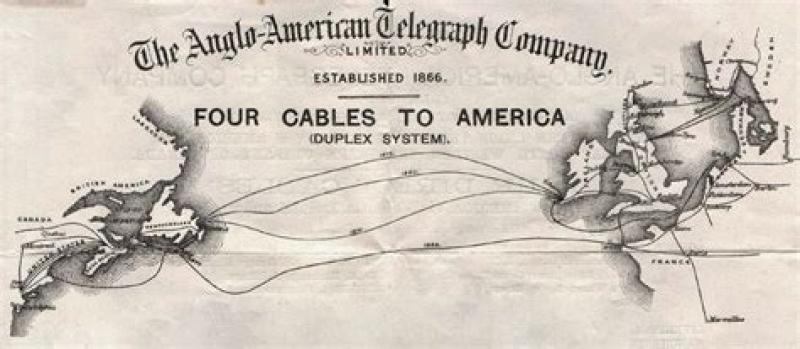
August 6, 1866. Atlantic Cable laid
After several failed attempts over the previous few years, a trans-Atlantic telegraph line was at last accomplished. Previous efforts had yielded some success, but the technology was still in the development stage. The first working line was completed in August of 1858, and Queen Victoria sent a telegram of congratulations to President Buchanan. New York City celebrated with a 100-gun salute, and the streets were decorated with flags and church bells rung. By September, however, the initial victory turned to loss due to insulation failure in the cable.
Cyrus Field, the initiator of the concept, with help from Samuel Morse, and investors Thomas Brassey and John Pender, refused to give up. The insulation of the cable was improved, and it nearly doubled in weight in the process. The Great Eastern was fitted to hold the 2,300 hundred miles of cable. Though the cable snapped on July 31, 1865, The Great Eastern steamed back to England and the quickly- formed Anglo-American Telegraph Company laid a new cable to replace the broken one. This time, the work was complete; in fact, two working lines were created.
August 13, 1704. The Battle of Blenheim
The Spanish Succession began after Louis XIV of France attempted unification of France and Spain under French rule. This act would have shifted the balance of power in Europe even further toward France, which had expanded greatly under the leadership of Louis XIV. What started the battle in earnest was Louis’ maneuver when he saw an opportunity with the death of the Spanish King Charles II, and used his troops to take hold of parts of the Netherlands Regions for one of his grandsons.
August 20, 1823. Marco Bozzaris, (1788-1823) died.
Marco Bozzaris was a Greek patriot, of whom the poem “Marco Bozzaris “by Fitz-Greene Halleck was penned. He was most remembered as a hero in the Greek War of Independence, wherein which he beat the Turks with a very small company of men, but he died in the battle.
August 28, 1609. Delaware Bay discovered
In 1607 Henry Hudson was hired by the Muscovy Company to find a Northern sea route to Asia. Not much is known about Hudson before this time. He set sail from England and north along the coast of Greenland. No other explorers had ventured this far into the north before. Icebergs and threats of mutiny accompanied Hudson’s early journeys. In April of 1609, a surly crew weary of the cold was the catalyst for Hudson’s decision to head for North America. He ultimately discovered the Delaware Bay, Manhattan Island, and the body of water that now carries his name, the Hudson Bay.
Published in U S Legacies Magazine July 2004
- Log in to post comments