
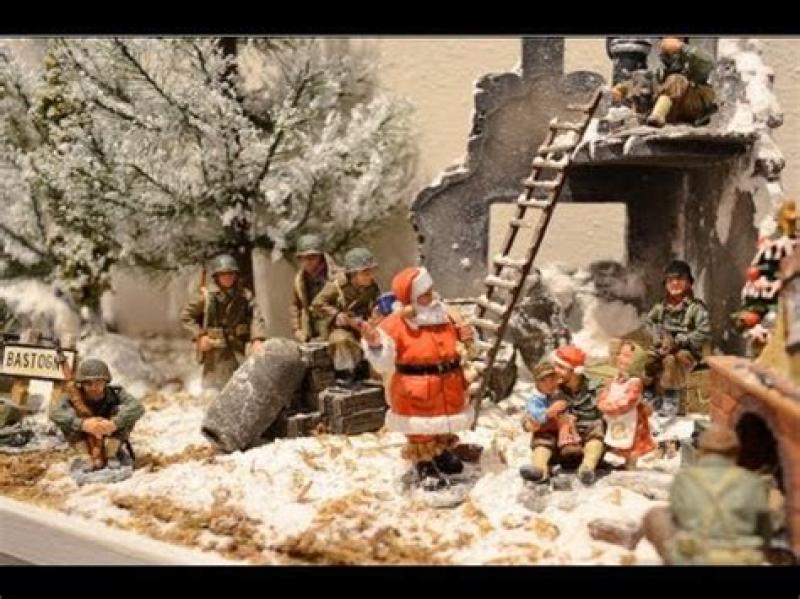
Christmas 1944
By Dr. Sylvia Morris
No snow capped mountain in this Southern climb
No brightly decorated homes this Christmas time
No clanging sleigh bells in the evening air
No voices blending Christmas carols fair
No cheery Merry Christmases across the backyard fence
Nor wishes for a good New Year hence!
And yet Its just as certain now this year, this day
This time of year, uncertain peace, we may
As so many years ago we heard
Again a miracle has occurred!
When I turn off the lights, and stand very still
I can hear thee angels sing the news of
Peace on Earth to Men of Good Will!
________________________
Sledding Memories
by Ruthann Wike
One Sunday afternoon, my mother, Helen Held nee Parker was recalling her childhood memories of snowy winter days. She said there was a steep hill behind the barn on her parents farm outside of Newtonville, Indiana. She liked to spend afternoons sledding down that hill.
One particular afternoon after a big snowstorm, Helen was on the sled with her little sister, Lois, sitting in front of her. The snow was just right to create a fast sledding surface. As they were coming down the hill, Helen noticed that they were traveling faster and farther than they had been earlier. She realized that at the bottom of the hill there was a barbed wire fence, and that they were not going to stop before they got to that fence. There wasn’t much time to think. She already had her arms around Lois. She pulled her sister to her chest and laid back on the sled. Thankfully, they sailed under the menacing fence with inches to spare. Even now, more than 70 years later, she still vividly recalls the panic that she felt that day, realizing that the fence could have seriously hurt both her and her little sister.
________________________
Did you hear about the cat that swallowed a ball of yarn?
She had mittens.
________________________
What do you call an un-natural fear of Christmas?
Claus-Trophobia
________________________
Did you hear about the vampire who first joined and then quit the Vegetable Club?
He quit because you cant get blood out of a turnip.
________________________
What did the boy volcano say to the girl volcano?
Do you lava me? I lava you.
________________________
When is it bad luck for a black cat to follow you?
When you’re a mouse.
_________________________
The Old Days
In the old days, they cooked in the kitchen with a big kettle that always hung over the fire. Every day they lit the fire and added things to the pot. They ate mostly vegetables and did not get much meat. They would eat the stew for dinner, leaving leftovers in the pot to get cold overnight and then start over the next day. Sometimes stew had food in it that had been there for quite a while. Hence the rhyme, Peas porridge hot, peas porridge cold, peas porridge in the pot nine days old.
Sometimes they could obtain pork, which made them feel quite special. When visitors came over, they would hang up their bacon to show off. It was a sign of wealth that a man could bring home the bacon. They would cut off a little to share with guests and would all sit around and chew the fat.
Those with money had plates made of pewter. Food with high acid content caused some of the lead to leach onto the food, causing lead poisoning death. This happened most often with tomatoes, so for the next 400 years or so, tomatoes were considered poisonous.
Bread was divided according to status. Workers got the burnt bottom of the loaf, the family got the middle, and guests got the top, or upper crust.
_________________________
The Origins of the United States Navy
The United States Navy was not actually born until 1794, well after the Revolutionary War had ended. By 1785, the Continental Navy had been disbanded for lack of funds under the Articles of Confederation. Former captains and sailors became crews of merchantmen or joined state navies, or became privateers.
As the 1780s wore on, more and more American ships became victims of British blockades or privateers, as both countries sought to capture the trade in the West and East Indies. Likewise American ships in the Mediterranean fell prey to the pirates of the Barbary Coast.
At last, the new U.S. government decided that America should have a standing navy. It commissioned six frigates: the Constitution, United States, Constellation, Congress, Chesapeake, and President. The first three of these were finished and launched in 1797; the last was completed by 1800.
Today, the USS Constitution still stands in Boston harbor, remaining afloat after nearly 210 years.
U S Legacies Magazine December 2005
- Log in to post comments