
Santa Rosa has a ghost that refuses to be forgotten. It whispers its name down the street that runs alongside the old Rural Cemetery, but as time passes, its memory becomes increasingly distant and its identity obscured. It’s name is Franklin, and it is the ghost of the town that died giving birth to Santa Rosa. Everyone in Santa Rosa knows Franklin Avenue, but only a few are aware of its history, and even that is sketchy at best. Until now, all we've known is that in the early 1850s, a man by the name of Oliver Beaulieu bought a beautiful parcel of land from the Carrillo family and established a small town on it. But within a few short years Franklin gave way to Santa Rosa and Oliver Beaulieu left the valley, his legacy reduced to being remembered only as a "French-Canadian fur trapper."
But who was Oliver Beaulieu? Who was the man behind the "fur trapper" myth? In 1999, some of his descendants were found who were thrilled to help solve the mystery. Listening to them leaf through the pages of Oliver's life is like reading an Old West adventure book, full of danger, intrigue and romance. But most of all, what his story contains is the type of formidable courage and spirit that defined the American frontiersman. His life spanned almost the entire 19th century, and the tales of him as he moved across the continent, battling every danger that God and Man could place in his path, are so notorious that they have been handed down from generation to generation of Beaulieu’s who know him today as Grandfather Oliver.
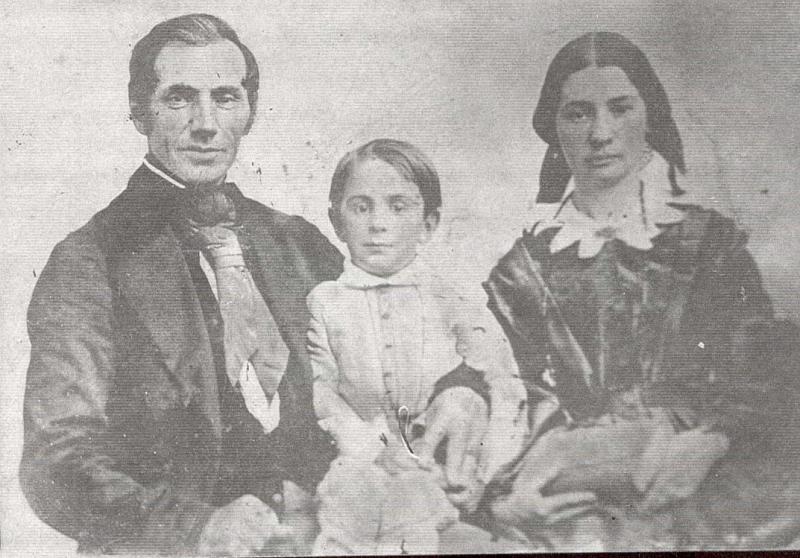
Here, in him, is an outstanding piece of early California history. Headstrong, adventurous, restless, multi-talented, tough and nobody's fool, these are some of the words his descendants use to describe him. The most common adjective they use, however, is "wealthy." Oliver attracted money, and a photograph taken of him in the early 1850s forever puts an end to the grizzled fur trapper image. With the face and bearing more like Cary Grant than Grizzly Dan, he could, if alive today, forego the dusty trail in favor of the silver screen.
The spelling of the name Beaulieu received quite a beating for most of the Oliver's life, and county records display every possible vowel transposition that can be imagined (Bolio, Bolew, Bolyo… at least fourteen different spellings have been counted). Very French, the name is traced to Pierre Hudon, a seventeenth-century Canadian who was awarded a manor for deeds-well-done. The name of the estate was Beaulieu, which translates as "beautiful place" and Hudon took the name for his own.
Oliver's life began on March 15, 1810, in Trois Rivieres, near Quebec. The son of a farmer and miller, Oliver's independent nature matured quickly. Nearly 200 years later, there is still whispered among his descendants several somewhat shadowy tales of Oliver's "stern" father, who, by today's standards, might have been considered abusive. At any rate, Oliver left home at the age of fourteen and spent the next seven years working and traveling throughout Canada and New England.
At 21 he landed in Boston and it was probably here, where he worked with a banker known as Childs, that he honed his great money-handling skills. Boston and banking held his interest for three years; then he moved on, traveling though Canada, New Hampshire and Michigan. While in Michigan he tried his hand at ranching but, the story goes, he was driven off his land by hordes of rattlesnakes. On the road again, his travels eventually led him to New Orleans.
In 1844, when he was 34, he joined Capt. John C. Fremont in the first of two expeditions that brought him to the West. His tales of adventure with Fremont include battling the perils of freezing weather, exhaustion, cholera and near starvation, but all the while he continued to build his personal fortune. By the time of his second Fremont expedition, his success was so well established that Beaulieu funded Fremont with $5,000, a loan that, his descendants insist, was never repaid.
But to the family, more important than the slight of payment is the slight of recognition. They believe that the mountain peak named for Fremont in San Juan Bautista, where Fremont is credited for spying Castro's army as they gathered below during the Mexican War, should really be named for their illustrious ancestor. Oliver told his family that it was he himself who first ascended the peak, and if not for him, Fremont would never have made it up the mountain at all. Beaulieu family lore avows that Fremont was in fact so ill that Oliver, after first scouting the mountain, returned to his company and carried Fremont up the mountain on his back. As an adult, Oliver's daughter Katherine lobbied every year until she died to have the name of the historic spot changed to Beaulieu Peak.
He left Fremont and went on to establish a tannery and distillery at Sutter's Fort, where he was in charge of producing saddles, brandy and aguardiente, an extremely expensive and potent concoction similar to cognac. His personal wealth was also growing through land deals he made in Sacramento. The county's Bidwell Park is said to be on land donated by Beaulieu.
The year 1846 found him in Sonoma as the distiller at General Vallejo's Lachrymis Montis headquarters. Old land deeds reveal that he was involved in many Sonoma County land transactions while he was there, and evidently he was no stranger to the old Blue Wing Inn. He was on site for the Bear Flag Revolution, Sonoma County's infamous addition to the battle for control of the state but exactly whose side he was on is a little vague. It is most likely that the independent Beaulieu was on the side of Beaulieu.
Barbara Warner, in her book The Men of the California Bear Flag Revolt and Their Heritage, lists him as a Bear Flagger, but somewhat reluctantly. Her research uncovered some evidence of a rumor that implicates Beaulieu of having acted as a spy for Fremont. It's a rather romantic notion that would be in keeping with Beaulieu's daring character but, if true, might be more in keeping with his mercantile side: he probably seized the moment and capitalized on it. Warner cites Vallejo as saying, after the revolt was over, that Beaulieu was the mallisimo oso superlativo - "the worst Bear of all." This may be because Beaulieu reportedly acted against Vallejo's orders by opening a bottle of the powerful aguardiente and passing it around the Bear mob. But considering that the men were half-starved and wholly exhausted (and therefore easily knocked out) one has to wonder what Beaulieu's real motive might have been.
Regardless of where he stood during the Revolt, there doesn't appear to have been any unconquerable bad blood between Oliver and the Vallejos or Carrillos. Not long after the dust settled on that piece of history, they were doing business together again, and David Mallagh, the husband of Juana Carrillo, was present in 1852 at Oliver's wedding.
Oliver chose Mary Hood for his bride. It is possible that she was connected with the powerful Hood family of Los Guillicos, but the legend handed down through the Beaulieu family is that she may have been of Native American descent. They had a son together, Oliver Jr., but their union was to be short-lived. Mary Beaulieu died within a few years of their marriage, but she has hardly been forgotten. The Beaulieu family still speaks of her today.
There are a couple of pieces of evidence that revise the history of the Santa Rosa Rural Cemetery. Until this study was conducted the popular belief was that the cemetery was started by the Fulkerson family in the 1870s. However, the headstones date back to 1854, and we know now that this was during the Beaulieu occupation. Also, there is a tiny line in the old Cemetery Records book, compiled in 1922, that flatly states "Mary Hood-Bolio" as the donor of the land in 1853 (unfortunately the book offers no hard proof of this). And it appears that there was no cemetery there in 1852, or pre-Beaulieu. This can be proven by a bit of unwanted notoriety that Beaulieu received that sensationalized the Valley in that year.
According to an 1852 edition of the San Francisco Chronicle, two men from San Francisco appeared at Beaulieu's door one evening that year. Five days later, both men were dead, and someone was spotted burying the men down at the bank of the creek. Scandal ensued and a coroner's inquest was demanded. The inquest revealed that the two men were Canadian-French friends of Beaulieu's partner Pinard and, having heard that the men were deathly ill, Oliver dispatched a buggy to carry them to his house so that they might recover their health. Unfortunately, the men were so advanced with Panama fever that the men died within minutes of each other a few days later. Fearing contagion to his family, Beaulieu wanted them buried immediately. Ultimately the inquest proved Beaulieu innocent of all possible misdeeds, and in the end praised him for his generosity and kindness.
Ten years later, the story was exposed again when a season of heavy rains caused the coffin and its skeletal contents to surface from it s muddy grave. Witnesses insisted that the case be reopened and Beaulieu was forced to clear his name for the second time. But the importance of the story for our story here is that if there had been a cemetery on the land at the time of the two deaths, the men would most likely have been buried there, not by the creek. This places the establishment of the cemetery between the years of 1852 and 1854, during the Beaulieu period. This was also about the time when Mary Beaulieu died, though the exact date or cause is still unknown. It is possible, then, to believe that perhaps the cemetery was not donated by her, but in honor of her. Mary Beaulieu may in fact have been the first to be buried in the Rural Cemetery.
Oliver sold his land in Santa Rosa in 1856 and moved with his son to San Jose. The family story is that he wrote home to Elise Pinard, who was probably his partner's sister, for her hand in marriage. Miss Pinard agreed, but only under the condition that if she were to travel to California from Canada, she must be allowed to bring her family. The deal was struck, and several Pinards are cited in the late-19th century Santa Clara Valley directories.
Oliver settled in San Jose in the prestigious Willows District. The home he built for his family was so elegant that it was included in the 1888 publication of Pen Pictures from the Garden of the World, a book that features Santa Clara County's preeminent citizens. He bought 190 acres of choice agricultural land and began life as an orchardist and vintner, while at the same time investing in the highly successful Almedan Quicksilver Mining Company.
Elise Beaulieu is remembered as being a very lovely and kind woman. Oliver is remembered as being strict and autocratic father, ruling his family with an "iron fist in a velvet glove," but much loved and respected nonetheless. Together, the Beaulieu’s had twelve more children. His four handsome sons were considered the town catches, yet none of the Beaulieu children were allowed to go to the neighborhood dances. (That didn't matter. They conspired and snuck out through an upstairs window after dark.) Oliver was a strict father, but music, art and literature were highly encouraged. Descending from him today is a line of prodigal and instinctive musicians.
He had a well-known temper. The courts in San Jose are laden with records of his complaints over stolen stock issues and the like. As he aged this temper seems to have caused him to become downright cantankerous, and there is within the family a rumor that someone once tried to have him committed to the local mental institution. During an interview in 1999, Jessie MacGraw repeated a story she heard as a little girl from her Aunt Katherine, who was Oliver's daughter. It's possible that Oliver had a hard streak in his nature, because Katherine remembered that her mother would often lock herself in her room and cry because of something Oliver had done or said to her.
Even so, most memories of him are fond ones and his reputation as a trustworthy banker withheld. Dorothy Beaulieu, whose husband was Oliver's grandson, reports that Oliver became an in-home banker and was nicknamed "Old King Midas." Dorothy also says that there was a room reserved in his house that he used as a vault to store the money and gold he had been entrusted with. His children were allowed to play games with the gold pieces as long as they were responsible about it, and the door to the room was stopped by bags of gold.
For the rest of his life, Oliver Beaulieu resided in San Jose, his days of free-spirited adventure coming to a peaceful close. He died of natural causes in his Willows District home in 1896 at the age of 86, the patriarch of a family still proud to tell his tales, none of which involve fur trapping. His elusive name-spelling problems were at last put to rest when he was. Carved into the tombstone, the inscription reads, "Beaulieu."
Copyright 2002 Kim Diehl
This story appeared in the January 2003 issue of U. S. Legacies Magazine
- Log in to post comments