

Left-Hand Picture shows British Officer in Macedonia issuing permits to natives to use roads. All travel being under military restrictions. Schoolhouse has been utilized as registration office. The teachers desk having been hauled out for the Officer to use. Right-Hand Picture shows British soldier behind Somme Front in France making wooden crosses to mark graves of the dead. French Government says that graveyards will be permanently preserved.
(Excerpt From Pathfinder Magazine Dated 1916 )
British Juggernaut Cars Win Battle.
The newspapers are filled with accounts of the surprise which the British in France have sprung on the Germans, in return for the various surprises Hans has sprung on John Bull.
We must make some allowance for a sensation of this sort, and not be carried away with enthusiasm. You remember how the daily newspapers gushed over the German U-boat Deutschland when it landed in this country. It was the forerunner of a huge fleet of similar undersea commercial liners, which were to break the British blockade, we were told. The Pathfinder at the time sounded a note of caution and pointed out how unreasonable it was to jump to any such conclusion; and that view has been vindicated by events since.
The British blockade is still on, in spite of the daring exploits of the German U-boat mariners, and the dye famine in this country is not relieved in the least. So again we warn our readers not to take too seriously the current reports about the traveling land forts which the British tried out for the first time in an attack on the Somme a few days ago. These new fighting devices furnish a picturesque subject for the imagination to enlarge on. They might have been inspired by some novel of H.G. Wells, telling of some masterful fighting machine of the Martians or of some other race of supermen.
It was early morning and the no-mans-land between the fighting lines on the Somme was wrapped in mist, when suddenly there appeared on the scene a herd of these new war monsters, which were almost as much of a surprise to the allies as to their enemies. The first temptation of the observers was to laugh outright at these strange fantastic war-engines, which suggested those armor-encased antediluvian monsters that we read about in geology-such as the ichthyosaurs, and so on.
They consisted of huge structures of steel, maneuvering on wheels and crossing rough fields, stretching over deep ditches, plunging unscathed over deep ditches, plunging unscathed through thick entanglements of barbed-wire, and even eating their way through groves of trees, pulling out the ones that were in their path and too big to be pushed over. The Germans at once concentrated their fire on these new champions of the ally cause but their shots rattled off them like rain off a ducks back. It is declared that only a direct shot from a big gun would put one out of business.
Meantime, from armor-protected loopholes in the sides of the great monster poured forth constant streams of bullets from a score of machine-guns, mowing a wide swath in the massed forces of the Germans who were protecting their first-line trenches and who had no way of getting back at their unearthly enemy. According to the descriptions, even the well-known German discipline and organization were demoralized when this array of land dreadnaughts emerged from the fog and began to feel their was laboriously but irresistibly forward, spitting deadly fire and spreading terror and panic.
Partly by the use of these new tanks, as the British have nicknamed them, the allies pushed their wedges a little farther into the German positions in the Somme sector. Reports differ as to just what these new engines of war are, and how they are made. Different men are given the credit for them. One account says that they were manufactured piecemeal in many different factories, so the secret would not get out, and were taken to France and assembled just back of the fighting front.

Some say they consisted of a small-sized fort mounted on four caterpillar tractors. An American concern at Peoria, Ill., has furnished about 1,000 of such tractors to the British, and they are used for many heavy-duty purposes such as hauling big guns, towing trains of supply-wagons, etc. The caterpillar feature has been described before in these columns. Suffice it that the wheels of the tractor, instead of traveling on the ground, run on huge corrugated belts, which thus furnish a track for them. They weigh about nine tons apiece, are provided with 120-horse gasoline engines and cost about $4,800 each.
Of course these tanks are not going to win the war, but they are an interesting new feature, and they show that the allies can exercise their ingenuity, as well as the Teutons. Their appearance has caused as much discussion as that of the little Monitor did during our Civil war. It is quite possible that the future will see such traveling forts developed to a high degree, just as the monitor idea was. But presumably they could be used only on ground that was reasonably favorable. Anyway their advent on the scene of war has made old Mars sit up and take notice.
One of the tanks came to grief, when it tried to negotiate a deep shell crater, toppled over on its side and became as helpless as a turtle or crab that has been turned on its back. This machine has to be abandoned by its crew and it is now left midway between the two hostile lines.
The Germans are extremely anxious to secure the new war-monster, so they can learn its secrets and produce machines of their own of the same sort, only larger and more powerful. The British are just as anxious to get it back of course. So there is a desperate contest going on for its possession, and attack has been made by both sides, without result as yet.
Big Dent in German Ring.
The British were able in the recent fighting to push their line forward, in some places several miles. They captured the villages of Courcelette and Martinpunich, which the Germans had stubbornly clung to for weeks. This materially widens the wedge, which the allies are driving into the German ring at this point.
The strongly fortified German Danube trench and the famous Wunderwerk (wonder work) redoubt, both near Thiepval, were taken by the British, through the Germans had long proclaimed them as impregnable. In two days 4,000 German prisoners were taken; then there was an enforced lull in the fighting owing to terrific autumnal rainstorms.
Though the Germans had sneered at the Somme push and declared that it could almost be ignored, it is evident that they realized now that it constitutes a serious threat to their ring. After having withdrawn a large number of their men from the western front and sent them to the eastern front to aid in the drives on the Rumanians and Russians, they hastily changed their plans and brought back a part of these troops after they had been taken part way to the eastern front.
Large new forces were sent into the Somme region, to back up the German line there and head off the allies, if possible, from advancing farther and taking Combles and Peronne, the two main German bases in that sector. Gen. Von Hindenburg himself is reported to have led some of the tremendous counter-attacks, which the Germans launched in order to regain some of the strategic points that had been lost.
The ranking German commander on this front is Crown Prince Rupprecht of Bavaria, and, like the German imperial crown prince, he is determined to secure victory no matter at what cost; defeat for him might mean the loss of his throne. Wave after wave of Germans, in solid masses, was hurled against the French line at Bouchavesnes (the point of the French wedge midway between Combles and Peronne) and fearful sacrifices were made.
At one time they succeeded in gaining a toehold in the edge of the ruined village, but this advance force was later annihilated by the French barrage fire. This barrage, as it is called, is like a solid wall of death-dealing missiles. A person who views it from a distance sees it as a dense cloud of smoke, rolling with mathematical regularity along the field of battle.
Near the ground this smoke is of a blackish, greenish or brownish hue, due to the plowing up of the shells. Higher up it is whitish, like steam, for here the shrapnel shells are bursting, and sending their innumerable sharp fragments of steel flying in a spray in all directions. It is easy to distinguish this shrapnel fire for it sparkles and twinkles, very much like some kinds of fireworks and like the spark-lets which the children set off on the 4th of July.
Artillery in this modern warfare does not fire at random, in the general direction of the enemy. Every gun is like a key on a titanic piano, and it is controlled from a distance by an officer who plays it according to the requirements and in fulfillment of a consistent and general plan.
The gunnery experts have the entire field all blocked out in advance, and the exact range of every square-yard of that field is down on paper. There is no deliberating and no stopping to tediously sight guns on some distant mark. The officer in charge has his directions given to him, and the gun is pointed accordingly, and touched off at a given signal. In most cases the man who sights the gun (picture Village of Mametz, Destroyed by bombardment, Taken by British in Somme Battle) doesn’t see his target at all, but the gun is not firing in the dark, as it might seem.
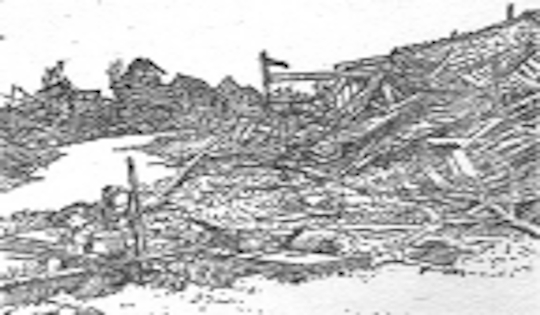
In the barrage fire, the guns are played along on the territory desired, not in a haphazard way but across the whole front, then back again a little farther behind, then across once more, and so on until every square-foot of the surface has been covered, and nothing missed. After the Germans have made an attack, for instance, the French get to work with their barrage.
They place this barrier of fire just far enough back so that the Germans who are making the attack cannot retreat, and those who are behind cannot be brought up as reinforcements without passing through a veritable hailstorm of flying steel. It is no wonder that almost entire regiments are wiped out in such warfare; the surprise is rather that any mortal could survive such an ordeal.
It is reported that the allies now have a great preponderance of guns and ammunition, and this fact is no doubt (picture Part of Vaux Fort, Near Verdun, Showing Havoc Wrought by German Big-Guns) telling on the western front, where munitions are everything. A captured communication signed by Gen. Falkenhayn, chief of the German general staff, tells the Germans, gunners on the allies side are told every day not to spare theirs but to keep up the fire and give the Germans no time for rest. This process, if kept up, can have but one result.
Mixed Results in East.
The fighting that is now going on in the Balkan region would itself constitute a great war. This fighting has not processed far enough to be decisive, one-way or the other. The Teuton-Bulgar-Turkish drive against the combined Rumanian and Russian forces in the Dobrudja district of Rumania, fronting on the Black sea, swept everything before it for the first week, as already reported. The central allies, marshaled under Von Mackensen, the hero of Germany’s last years drive against Russia, occupied all the southern portion of the Dobrudja, namely the territory which was taken from Bulgaria and given to Rumania after the second Balkan war, as it is called.
It looked as if Von Mackensen would, by means of the well-known Teuton hammer-blows with big guns, blast his way right through to Bukarest, the Rumanian capital. But the Russian seem to have buttressed up the Rumanian defense sufficiently to stop the invasion.The line where the allies decided to make this stand runs along the railroad, which connects Bukarest with the Rumanian Black seaport variously known as Constantia, Constanza and Kustenji. If the central powers get possession of this railroad it would cut Rumania off from her most valuable inlet and outlet for supplies.
It appears that the allies were able to concentrate enough forces on this line not only to force Mackensen to put on his brakes, but also to back up considerably. The Berlin account says that the fighting on the Dobrudja front has come to a standstill, which is an admission of defeat, in official language. The allies claim to have driven the Teuton forces into retreat and won a telling victory there, as the climax of a terrible six-day battle.
On the other hand the Germans and Austrians have driven back the Rumanian army of invasions in the Carpathians, and wrested two of the mountain passes from them. They are now beginning a new drive against Rumania on the western frontier.
The Teutons and Russians mean-time are engaged in hard fighting at different points on their front, from Riga in the north, down through Volhynia and into Galicia. At some points the Russians have made additional gains, while at others they have been hurled back somewhat.
On the southernmost Balkan front, in Macedonia, there is also active fighting. The revived Serbian army, consisting of the remnant of the soldiers who escaped from Serbia during the Teuton conquest of last year, is holding the allies western or left wing. The British have charge of the center, and the French are responsible for the right. They are all backed up by the way they are sparring for time there; they probably (picture Big German Siege-Guns Taken by French on The Somme) haven’t more than one-third that total. They are launching attacks against the Bulgars north of them, but not with the degree of punch that would indicate a force of 600,000 men at hand.

However, there is a good deal of secrecy about this matter and it may be that the allies have more soldiers there than the signs indicate and that they are only waiting for a more favorable moment for letting them loose. Everything in that quarter is waiting more or less on the way things shape up in Greece.
Greece is on the brink of war, of one kind or another. If she doesn’t get into the big war, it is likely that she will have a revolution on her hands. No doubt the allies are delaying in order to be assured as to the attitude Greece is to take. And the Teutons are desperately taking advantage of this delay to push their drives home.
The Serbs have won some glory and satisfaction by attacking the Bulgars on their end of the line and driving them back toward Monastir, so that now they are fighting on their own soil. The French at the same time pushed forward and captured Florina and other Greek towns, which the Bulgars had taken some time ago.
The Italians are aiding in the Balkan campaign by sending an expedition down through Albania, with a view to ultimately linking up with the allies in Macedonia. The Greeks occupied a portion of Albanian territory earlier in the war, and they have had to give up this territory as the Italians have occupied it.
The allies are playing off Italy against Greece. Both Italy and Greece covet this Albanian territory. The allies want to show Greece that Italy is going to get this prize, and thus induce her to join in the war on their side.
Greece is almost persuaded, but King Constantine says that the losses which war would entail would be too high a price for Greece to pay for any advantages she might secure. The allies are prodding him from behind, while the Teutons are threatening him from in front, and between the two he is in a bad dilemma.
Meantime snow has fallen in the Carpathians and the armies are beginning to look forward with sad hearts, to the necessity of passing another winter in the field. There are no signs of either side weakening to any considerable extent, and the chances all point to the prolongation of the war for the best part of another year at least.
Published U.S. Legacies February 2006
- Log in to post comments