
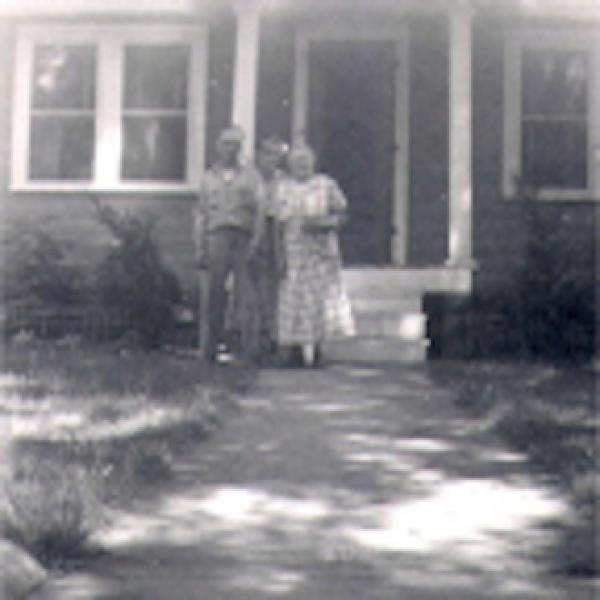
1956 photograph of Warren Hostetter, his wife Marion Hostetter and his mother Lizzie Hostetter in South Bend, Indiana.
By Franklin T. Wike, Jr.
Almost a year ago, I moved from a small apartment in Birdseye, Indiana, to an 80 acre farm in Grandview, Indiana. One of my goals when moving to the farm was to put in a vegetable garden, so this spring I tilled up a part of our back yard and started planting vegetables. Now, early in the mornings before I start working on the computer, I go out to the garden and pull weeds, or pick vegetables. This morning, while working in the garden, I started thinking about my grandparents, Warren and Marion Hostetter, and the farm they had. My grandparents had 6 boys and 2 girls. Two of the boys died shortly after birth, so my mother Verna Wike nee Hostetter was the oldest child that survived. My mother was also the first one to have children of her own, therefore, my brother Donald Wike and myself were the oldest grandchildren.
My grandmother Marion Hostetter nee Leedom, was born May 19, 1903, in Elizabethtown, PA, and my Grandfather Warren was born April 9, 1902, in South Annville, PA. They got married in 1925 and continued living in Pennsylvania where my grandfather drove a truck for a living.
After The Great Depression was over, my grandparents moved to South Bend, Indiana, where my grandfather started working at the Studebaker plant, plus they had a small truck patch (mini farm) in Mishawaka, Indiana.
I mentioned earlier that I moved to a farm almost a year ago and yet to this day, I still can not remember my new phone number or mailing address. For some unexplained reason, I seem to have problems remembering certain facts and events and that is one of the reasons I am recording these memories while they are still available. Some of those memories that still exist include my grandparents house pictured above. The address was 602 S. 36th. St., South Bend, Indiana, and their phone number was Atlantic 88894. Their house was usually painted a turquoise with white trim or white with a turquoise trim. I think they repainted it about every other year. While scanning in a photograph of their house for this article, one of the things I remember about their front door was the key they used. It was a skeleton key and they always kept it in the lock, but the only time they ever used it was at night or when they were leaving. That struck me as a bit strange because I never saw them lock the back door. I guess that was because life was different back then and people were more trusting.
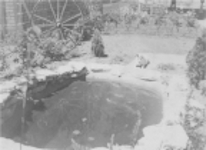
In the back yard, they had a fish pond. I was always told to stay away from the edge because in spite of the fact this fish pond was not very wide, it was about three feet deep. My grandmother had a VERY large aquarium inside the house, located on the back porch. Every fall, my grandparents would take all of the gold fish out of the pond and move them into the aquarium on the back porch. However, I remember one winter when there was an early freeze and they did not get the goldfish out in time. The pond froze over with the fish still in it. My grandmother was worried, but when spring came and the ice thawed, all of the fish were ok, so from that time on, I don’t remember them moving the fish anymore.
I started this article mentioning my garden, so let me tell you a bit about my grandparents farm. It was located on Current Road in Mishawaka, about 10 miles from their home in South Bend. They only had about 10 acres of land, but it was enough for them. At the very front of the farm, they had around 300 blueberry bushes. These were cultivated blueberries and I don’t know how my grandfather got them to grow so large, but compared to the blueberries you buy in the grocery store today, his were gigantic.
Back in the early 1950s, my mother, brother and I were still living in Pennsylvania and during the summer, my mother would place my brother and myself on a train and send us to Indiana. My grandmother would meet us at the terminal in South Bend and pick us up. That allowed us to spend time with our grandparents, plus we were available to work on the farm during the summers.
In 1958, my family moved to Indiana permanently and from that point on, my brother and I were available to help on the farm any time we were needed. And speaking of being needed, it seems like the greatest need was during blueberry season. I can remember many mornings when we would start picking blueberries at 5:00 am and work until noon, eat a quick sandwich that my grandmother had packed, and then continue picking blueberries until 5:00 pm. Twelve hours per day, 5 days a week, were spent sitting on a 5 gal bucket, filling them with blueberries. It normally took us about a week to make it through the entire patch of 300 bushes, and by that time, we could start over at the beginning of the patch.
I never thought much about it at the time, but now I wonder how my grandfather was able to take so much time off from his job at the factory every summer.
Saturdays, we would have to sell all the blueberries that we picked that week. My grandmother would go through the buckets and clean out any debris or damaged blueberries. The rest of the blueberries were placed in quart containers and she always made it a point to place the largest blueberries on top and to make sure that quart container was heaping full, unlike the ones you get in the store that are even with the edge of the containers.
After my grandmother filled all the containers with blueberries, she would load my brother and myself into her car and drive us up and down the streets. Don and I would walk from door to door carrying one quart of blueberries at a time. We would show this quart to the homeowner and sometimes even let them taste some of the blueberries off the top of the quart. I have no idea how many we sold in one day, but I know that we sold them for 50 cents per quart and that it would take us all day long to sell everything we picked that week.
Another thing I remember about those summers on the farm was that we did not have any air conditioning available anywhere. My grandfather did not have air conditioning in his truck, nor did they have any available in their home, yet for some reason the heat did not bother me near as much back then, as it does now. I guess our bodies and minds got used to the heat.
In addition to the blueberries, my grandparents also grew yellow wax beans, green beans, cucumbers, Country Gentleman White Sweet Corn, watermelon, cantaloupe, tomatoes, potatoes, strawberries, pumpkin, Lima beans, cabbage and many other vegetables.
They also had field corn which was used for my grandfather’s Golden Palomino horse named Trigger and for the cows. They always had one or two steers they would keep in the barn and fatten up for their own use and I can remember having to stack hay and straw into the hayloft on top of the barn. That had to be one of the hottest jobs I have ever done in my life.
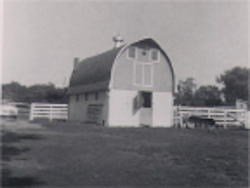
The barn was also used to store my grandfathers corn sheller. He used to shell his corn by hand and I was the one that had to remove all of the husk from the corn before he could shell it. I don’t remember the name of the tool I used, but it had a leather strap about an inch wide that would fit around my hand and a metal piece sticking out between my thumb and index finger that had a dull point on it, almost like the point on an old style hand can opener. I would hold the ear of corn in my left hand, then slide the point of that tool from the tip to the base of the ear, thus slitting the husk without damaging or cutting any of the kernels. Then I would have to pull all the husk, silk and any other debris off the ear and hand it to my grandfather.
I have been looking around in several antique stores for one of those huskers, but so far, have not found one. Hopefully, some day I will. I wouldn’t want to have to use one again on a regular basis, but memories of the days spent working with my grandfather, are very special to me.
Several years ago, I spoke with my Uncle Clyde Hostetter and he informed me that he still has that old corn sheller and that it originally came from his grandfather, Harvey Hostetter. Hopefully, some day if my uncle ever decides to sell that sheller, I would love to have it so that I can make sure it stays in the family for many generations to come. He also has a very unique hand cultivator that my grandfather had on the farm and I would give anything to have that tool. I have looked for a tool like those hand cultivators all over this country and could not find one, so there is a part of me that wonders if my grandfather might have designed and made them himself.
I mentioned earlier that my grandparents had a horse named Trigger. I remember one day when my grandfather allowed me to ride Trigger around the corral. To me, that was the perfect way to cool off and enjoy life a little bit. At least it was fun until Trigger decided to throw me off, right on top of the manure pile. I don’t recall what my grandmother might have said to me when we got home, but I have a feeling that I had to take a bath before supper that night, even if it wasn’t a Saturday night.
Supper was always a welcome part of the day, especially after working out in the hot sun all day long. I remember my grandmother making a full meal every night of the week and yet when we went to the grocery store, the only things I can remember her buying were butter, (the real thing, never margarine) milk, coffee and once in a while she would get a 6 pack of Dr. Pepper. My brother and I got to share one bottle, maybe one or two nights a week.
I mentioned my grandmother cooking every night. Making everything from scratch. I don’t recall her EVER having anything frozen except maybe some of their beef. In addition to the cooking and driving us around to sell the blueberries and/or other produce/vegetables, she also helped on the farm. There were may days she would spend the entire day on the farm (in her long dress and apron) hoeing weeds, planting seeds, painting the barn, feeding the horse, and picking vegetables, before going home to cook supper.
The only time she did not fix a hot supper was on Sunday. As soon as she got home from church, she would start cooking a big Sunday dinner and then on Sunday evenings, we would have cold cuts for sandwiches.
As time permits, I will write more about my grandparents, mainly because my relationship with them and view point was totally different than the relationships my mother, aunt, uncles or cousins had with them. Everyone views a person in a different perspective and I want future generations to learn about the people I grew up around and learned to love and respect. If any of my cousins, aunt, uncles or any other relatives read this article and have additional information or stories they would be willing to share about my grandparents, I would love to hear from them.
My summers on the farm, taught me that work can have its own rewards. I know I feel good when I accomplish certain things, regardless if it is publishing a magazine, planting, growing and cooking vegetables, or painting a building. Some of the things I can accomplish today, I learned from my grandparents. But more importantly, by watching, working and living with them, I learned there is a feeling of self gratification in growing your own food. Somehow it tastes better when it was your sweat that made it grow. I also learned that working together as a family creates a special bond and appreciation for each other. I could see that appreciation in my grandparents eyes, when they looked at each other or when their hands touched. May their legacy and their love, live on forever.
Published U. S. Legacies August 2005
- Log in to post comments