
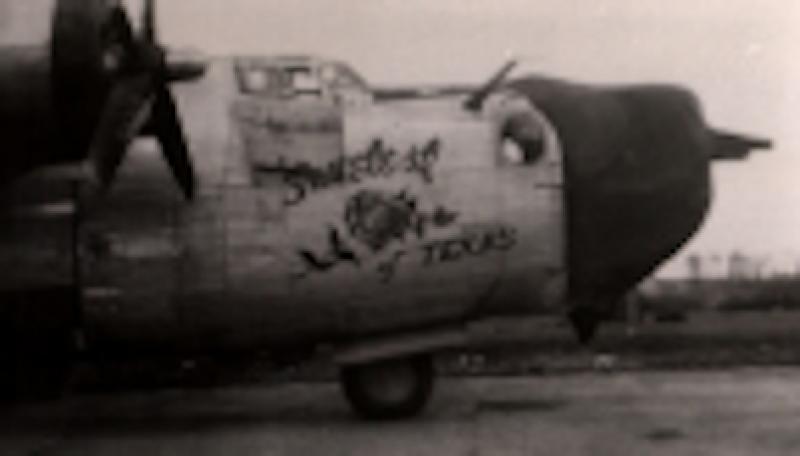
An image of the "Sweetest Rose Of Texas"
Based On A Personal Interview
By Darin L. Kress, D.Min.
On June 6, 1944, the beaches of Normandy were taken back from the Germans by 176,000 troops, over 12,000 airplanes, and almost 10,000 watercraft. It was bloody and brutal, but "Private Ryan" was saved and Hitler was in full retreat.
By August 1944, Paris was back in the hands of the allies and bells were once again ringing in the churches. By September 9, Belgium cities had been liberated and General Omar Bradley would soon be putting his infantry near the industrial region of the Ruhr. Despite the pounding of V-2's on London, the war was turning in favor of the allies. This is when destiny called 23 year old lieutenant colonel, Paul Swofford.
By September 27th, 1944, Swofford had piloted only six combat missions in the B-24 Liberator. He was about to discover that seven was his lucky number.
It was a known fact that no combat plane could fly faster or take more punishment than the B-24. World War II probably could not have been won without it. It was called, "the flying boxcar," because when fully loaded, it weighed over 60,000 pounds and 8,000 of those pounds were in bombs alone.
The B-24 required a pilot, copilot, navigator, radio operator, bombardier and three to five machine gunners for the moveable turrets. On September 27, 1944, Lieutenant Swofford departed Tibenham, England with a crew of nine. Little did he realize when he entered the briefing room with 38 other pilots that cool, Wednesday morning that 31 of them would not return from their mission.
The commander pulled back the curtain to reveal the day's mission: a bombing run on an aircraft plant in Kassel, Germany. American bombers had already delivered a series of crushing blows against Luftwaffe production during "The Big Week," February 20-25, 1944. Continued campaigns by the B-24 would mean that Nazi's most deadly air strike force would cease to exist in 8 months.
Swofford was set to fly into what the history books would later call, "The most disastrous raid for a single group in air force history." He was a part of the famous, 445th bomber group, the same as young brigadier general and actor, Jimmy Stewart. Stewart had 15 combat missions under his belt on September 27, 1944, but with his rank, he did not fly every mission. As providence had it, the young actor did not fly that day.
The 701st Bomb Squadron was scheduled to participate with three other squadrons in a three and one half hour flight to the interior part of Germany where they would release their bombs on an aircraft production plant in Kassel, then return to England. The day's forecast was cool and clear with a chance of rain. Of course, at 20,000 feet, it was always cool in the B-24, even with a flak jacket and cold flying suit.
Entering the "Sweetest Rose of Texas" through the bomb bay door, Swofford sat in the pilot's seat and buckled the belt. After his pre-check, he gave orders to be hooked up to an auxiliary power unit nicknamed, "the putt-putt," for its sputtering sound. The two-stroke noise and blue smoke meant it was time to crank the four Pratt and Whitney 1200 horsepower engines. Swofford's call letters that day were "105 Oboe," and his place after takeoff was on the extreme left toward the rear of the squadron.
What goes through a pilot's mind for three hours as he heads to a combat mission? Does he think about how cold it is in the cabin and wonder why the government doesn't put heaters in their planes? Does he concentrate on keeping in his place in the squadron? Perhaps he commented now and then about the beautiful North Sea channel and the Belgium landscape.
Did he think about life after death and the possibility that what happened to the crews at Ploesti five months earlier could also happen to him? Was he able to eat his breakfast that morning and sleep the previous night?
The old black and white television show, "12 O'clock High" made it seem so calm and easy. Did the thought of being in Nazi airspace and possibly in a Nazi prison camp make his mouth dry and his stomach ache?
As he neared the target, he gave the order, "Flak suits on men and keep a sharp eye for enemy fighters!" He stayed in formation, relying solely on the lead navigator to keep all 35 pilots headed in the right direction. Finding the Kassel aircraft production plant was difficult in the best of circumstances, especially with heavy cloud cover.
The lead navigator relied on visual and primitive radar and all the other men in the 445th bomber group relied solely on him. When the navigator signaled to the rest that they were over the target and it was time to toggle, Swofford knew something was wrong. Where were the American P-51's and P-38's? Where was their fighter protection? Why were they alone over the target?
Within minutes of the closing of their bomb bay doors, 100-150 Nazi fighters from Herman Goering's yellow nosed squadron swarmed in from above with their 20 millimeter cannons firing. Swofford described the next six minutes as "lasting an eternity."
 His gunners opened up their 50 caliber machine guns on the Messerschmits, but they were just too fast. Suddenly, the plane shook and Swofford saw other B-24's blowing up in midair all around him. He swerved to miss the pieces of the exploding debris and listened to the bullets ricocheting throughout his plane.
The radio operator screamed, "I'm hit in the leg!" A few seconds later there was a loud "bang" and the copilot confirmed, "There go the hydraulics. Nothing responds." Then he added, "the stabilizers are out and we just lost engine number two." The plane yawed and slowed and Swofford struggled with whether to feather the props or to let them keep spinning. He decided to let them spin so the Nazis wouldn't know that he was hit and sense an easy kill.
A Folkwulf 190 suddenly appeared with guns blazing. From the rear turret, someone yelled, "I got him!" All around, B-24's dipped their wings and parachutes opened on all sides. As the radio man screamed for a tourniquet, another pop sent shattering glass through the cockpit.
Swofford felt warm blood running down his face and saw his copilot covered in blood from the flying glass. Still flying at 22,000 feet, he prayed that his oxygen wouldn't be hit. Then he realized that he was losing power. Once again he yelled, "Nobody bails until I give the order."
Bailing out was always a last resort because it was an admission of defeat. To bail out over Germany meant a stay in Stalag Luft 1, a prisoner of war camp in Barth, Germany. It also meant a good possibility of being tortured and killed by the Nazis.
Swofford reasoned, "As long as we're still airborne and there's one drop of American blood left in my body, this plane will keep flying." Wind whistled through the broken glass of his cockpit and he continued to fly.
Minutes later, he saw a beautiful sight. It was late, but still, very beautiful. Up ahead the afternoon horizon was filled with American P-51 Mustangs and P-47 Thunderbolts bearing the white star on the blue background. They angled in toward the gray Me-109's bearing the black cross. The flash from their wings signaled they were in full attack.
As Swofford scanned the sky, he saw only three other B-24's heading back toward England where 35 had filled the sky just ten minutes earlier. Some were still crashing. Two would make it to an alternate landing site. Only the "Sweetest Rose of Texas" and three others would return to the Tibenham, England runway where their flight had originated.
Having only three good engines, Lt. Swofford and his crew struggled to stay with the other three B-24's. The other three cruised at over 230 m.p.h., but Swofford with only three engines, pushed full throttle at 180 m.p.h.
For one and one half hours, the Sweetest Rose of Texas flew all by herself over Nazi Germany. The radio was gone, the crew was injured, but they continued to fly and ignore the stinging pain and the icy cold.
A sigh of relief filled the cold cockpit when the navigator announced that they were over Belgium. A quiet concern fell over the airmen when they soared over the English Channel. How would the loss of hydraulics affect the landing gear? Would the engines last until they landed? Could the plane be kept on course?
By mid-afternoon, 105 Oboe was on final approach when the strangest thing happened. A young controller in the tower fired the no-land flares, which waved off permission to land. Didn't he realize that when you are wounded and flying on three engines without hydraulics that it was O.K. to land on the wrong runway? Did this young controller realize that this crew was returning from "the most disastrous raid for a single group in air force history." Obviously not.
Swofford called out, "Gear up!" The tired crewmen struggled to crank the 1000 pound landing gear back into the belly of the plane. Swofford gunned his three damaged engines, banked a hard left and brushed the tops of the trees at the end of the runway. At 500 feet, the other runway was spotted and Swofford called out, "gear down, gear down!" Once again, crew members started cranking.
No hydraulics meant no brakes. The 55,000 pound bomber rolled off the runway and slowed to a stop in the thick grass. Finally, it's three faithful engines chugged to a stop. Both pilot and copilot released their blood stained seat belts and struggled to stand. The bomb doors opened and gave birth to a bloodstained crew.
As Swofford stood and exited the bulkhead, he turned to bid a final farewell to a cockpit that was filled with more providence than glass. Did he realize that he had just made history? Did he realize that only three other B-24's had returned with him? Was he lucky or blessed?
As he silently rode to debriefing still covered with blood, his commanding officer's first question was, "Where's everyone else?" Swofford replied, "They didn't make it." The base doctor acted like he hadn't heard and mechanically continued to pick broken glass out of Swofford's scalp and face.
After being patched up, Swofford meandered toward the mess hall for supper. It had been a long time since breakfast. What he saw as he entered the mess hall bothered him more than seeing his comrades' planes being shot out of the sky. There were hundreds of empty chairs and too much food for the few people who sat alone at tables. Laughter and talking had been replaced by silence and disbelief. The kitchen help went home early that night.
The next morning, supply trucks were dispatched to pick up the effects of the 237 American airmen who were reported killed or missing in action. At least 116 were killed that very day. The others parachuted out and were kept in German prison camps until the war was over. But Lieutenant Paul Swofford was among the fortunate few who survived the Kassel Mission by returning to the group's home base at Tibenham, England.
Other than the Purple Heart for the radio operator, none of the survivors of the Kassel Mission on Swofford's crew were ever awarded any medals for that mission. Their conspicuous gallantry and bravery for what took place on Wednesday morning, September 27, 1944 over Kassel, Germany have yet to be recognized by the United States government. Still, Swofford and his brave survivors continued to serve their country in future combat missions and some like Swofford, were shot down in future missions.
Paul Swofford retired with the United States Air Force after 24 years of service as a Lieutenant Colonel. Of the four crews that returned to Tibenham, England on the day of the mission, Lt. Colonel Swofford is the sole surviving pilot.
Somewhere in an old air force hangar are the forgotten remains of "The Sweetest Rose Of Texas." Inside the cob-webbed cockpit are the faded 59 year old blood stains from that fateful trip. Hitler is gone, the Nazis are gone, and the Luftwaffe planes are gone. Most of those who flew in the Kassel Mission are gone. Colonel Swofford still lives in Lakeland, Florida and is very active in his church. His story will not last forever. His blood stains will.
By Darin L. Kress, D.Min.
Copyright, 2003.
A Tribute To Those Of The Kassel Mission
By Darin L. Kress, D.Min.
Published U.S. Legacies February 2004
- Log in to post comments