
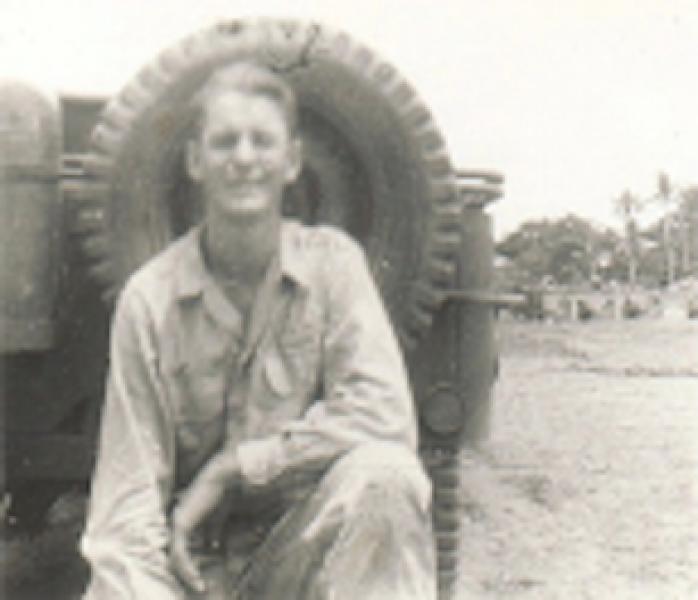
Submitted by Jessica Winchenbach from handwritten notes from her grandfather, Keith L. Winchenbach
Final Chapter
From Soldier to Civilian
The relief of returning home was not like anything that I had ever experienced, or have since that time. It was so good to finally be reunited with my family after not seeing them for almost two years. Things were generally the same. Both of my parents were working as hard as ever, and my sisters were bopping around as they had been when I left. Some things had changed in town, which seemed drastic before I got used to them, but I was content with being back.
After returning home to Waldoboro, 27 months after I had been inducted into the Army, I worked with my father delivering feed to farms for a while. However, after a few months of that, I decided to go back into the poultry business. Together, some carpenters and I built a three story 100 by 24 foot building. Father and I dug the cellar by hand with an old tractor and a one man scoop. It was quite a comical scene. I would drive the tractor and he would set the scoop up in order to fill a bucket with dirt. The funny thing was that if the speed of the tractor was too fast, the scoop would pull him up and over. Then I would slack off and he would fall on his behind! We had a few words about this.
I remember spending much of my spare time conversing with elderly men every evening after work. Many of us would gather after work at Elden Borneman's Store, and listen to the world news on the radio. We all became very great friends. If any one of us needed help we would all pitch in and get the job done. I recall one time when a hurricane tore Albert Genthner's barn roof off, and we all helped replace it quickly. I also helped when people fell ill, doing their farm chores until they got better. I even did Sam Winchenbach's chores for weeks, despite the fact that he had three sons near by to help him.
After building the hen pen, I managed to obtain about 2000 layers, collectively producing about 1200 dozen eggs a week. I raised all of the replacement stock new each year. I also raised several thousand broilers, roasters and some capons. I peddled my dressed poultry to clients that I had accumulated before going to the war, as well as picking up some new clientele.
I had a large John Deere tractor and did custom mowing, raking, plowing and harrowing. On top of all of this, I raised quite a bit of garden produce. I also started to raise peas. I harvested about a hundred bushels a season, and peddled those as well. I sold my produce in the summers and the poultry throughout the rest of the year. During this time, I also helped to build houses, and developed a knack for the carpentry trade.
On February 15, 1948, I was married to Frances Mae Creamer in Waldoboro, Maine.
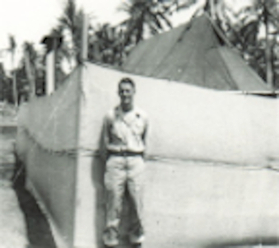
Myself, my tent and the picture screen in the Phillipines.
We lived on the farm, which was built in 1820, and where five generations of my family had been born. My first son was born roughly a year after our marriage. Curtis Loring came into this world on April 4, 1949. He was healthy, as were all of my children after him. I remember when he was about four or five, and he discovered bees. He pounded on a bee hive with a rock, until the whole swarm came out and greeted him, covering him with stings! He learned a lesson that day, that surely was never forgotten. Curtis was followed by Cathy Jean, who was born October 23, 1950.
She was, and still is, so much like my mother. After my mother's death, it was Cathy who became the leader of the family. She is now the matriarch, and stands as a major pillar in the family as it is today. Next, Frances gave birth to Teresa Jane, almost exactly one year later on October 28, 1951. Terry, too was self sufficient, as both my Mother and Cathy were. After three years, Sandra Fae was born on July 20, 1954, and shortly after, my youngest son, Craig Allen was born May 8, 1957. Together, we lived as a family, along with my parents for ten years on the old farm.
In 1956, I became a partner in the feed business with Father. I did this because I was not making enough money on poultry alone to take care of my growing family. The first year of my come back to the poultry business, we made $3.25 a bird, which was unheard of at the time. My father said that it was his management that made me so successful. So, I began helping my father in the feed business, and at the same time, I raised my poultry.
In order to be closer to the business, I decided to build a large Dutch colonial house behind the grain mill. The site that I had chosen for this house was at one time a cider mill, where they pressed apples to make cider. There was a large pile of apple wastes sitting on the site of my future home. So, I went into the woods and cut 43,000 board feet of lumber, which was twice as much as needed for the house. I then stacked this lumber so that it would dry. However, I traded some lumber for sheet rock and other materials that I needed. The house had four bedrooms, two bathrooms, a living room, dining room, kitchen and two long hall ways.
I built the entire house in seven months, primarily with my own hands. The only help that I had was a fourteen year old boy who helped set the rafters, a neighbor who helped put on the outside finish, and another boy who helped me put the sheet rock on the ceilings. I did all of the cellar form work myself. I built the forms for the cement cellar using the abundance of lumber that I had cut and prepared. I even mixed the cement by hand, which was one of the most laborious tasks of the whole construction of the house. The cement for the floor came from a derailed cement car, about 1000 feet up the railroad tracks from the house.
I had a well drilled, a septic tank put in, and a lot of fill hauled in. I did the plumbing, but had someone else do the wiring. When I was finished, the total cost of building was $13,200, or about $6.60 per square foot. Today, it costs at least 15 times that amount. While I worked on the house, Frances took care of the kids. She also managed to pick up about a thousand eggs from the hens a day. How she did this, I do not know, but it sure helped our finances at the time.
Just a Few Lines:
The Memoirs of Keith L. Winchenbach
Submitted by Jessica Winchenbach from handwritten notes from her grandfather, Keith L. Winchenbach.
Published U.S. Legacies September 2004
- Log in to post comments