
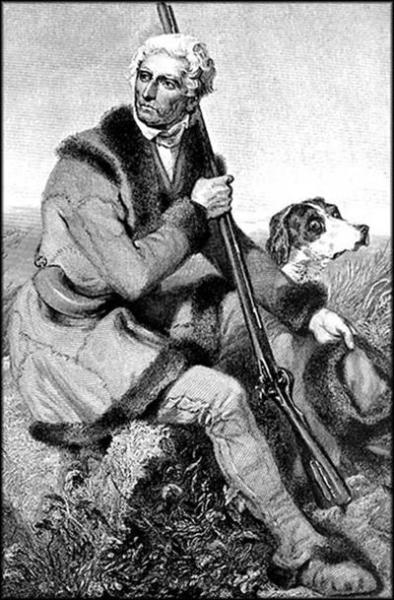
Portrait of Daniel Boone
Author: Anonymous
November 2, 1734
Daniel Boone was born. He was a frontiersman and explorer. He was captured and adopted by Shawnee Indians as Big Turtle. He died Sep 26, 1820.
November 24, 1784
Zachary Taylor was born. He was the 12th U.S. President [1849-1850]; married to Margaret Smith [one son, five daughters]; nickname: Old Rough and Ready; died July 9, 1850.
November 1, 1864
Money orders were sold by the U.S. Post Office as a safe way to make payments by mail.
November 8, 1864
Abraham Lincoln, the 16th president of the United States, was re-elected this day. He defeated Democrat George B. McClellan and carried all but three states, getting 212 of 233 electoral votes with 55 percent of the popular vote and 212 of 233 electoral votes. “I earnestly believe that the consequences of this day’s work will be to the lasting advantage, if not the very salvation, of the country,” Lincoln told supporters.
November 16, 1864
To celebrate General Sherman’s march to the sea, Henry Clay wrote the song, “Marching Through Georgia.”
November 26, 1864
Charles L. Dodgson, whose pen name was Lewis Carroll, sent a handwritten manuscript, titled “Alice’s Adventures Underground” to Alice Liddel. It was an early Christmas present to the 12-year-old girl. Later, the manuscript was renamed “Alice in Wonderland” and “Through the Looking Glass.” In 1933, the film version of "Alice’s Adventures in Wonderland" starred Gary Cooper as the White Knight, Edward Everett Horton as the Mad Hatter, W.C. Fields as Humpty Dumpty, Cary Grant as Mock Turtle, Jack Oakie as Tweedledum and Charlotte Henry in the title role of Alice.
November 7, 1874
Thomas Nast, a political cartoonist for “Harper’s Weekly,” created a satirical drawing of an elephant about to fall into a giant hole. The elephant represented the Republican Party and was used in reference to Ulysses S. Grant’s possible bid for a third term. Grant was a Republican. The symbol stuck and has been used ever since to represent the G.O.P. both in political cartoons and by the party itself.
November 24, 1874
Joseph F. Glidden of DeKalb, Illinois found just what he had been waiting for in his mailbox. It was the patent for his invention: barbed wire.
November 15, 1884
Samuel Sidney McClure of New York City started the first literary syndicate, the McClure Syndicate. It bought authors’ works and then sold the right to print them to various newspapers across the U.S.
November 25, 1884
Swiss-born scientist John B. Meyenberg of St. Louis, MO came up with a nifty idea that earned him a patent this day: evaporated milk.
November 1, 1894
The publication, “Billboard Advertising,” made it to desks for the first time. The periodical cost 10 cents. A subscription to the weekly magazine currently costs about $250 a year and is known as “Billboard,” the longtime bible of the radio and music industry.
November 8, 1904
Theodore Roosevelt, the 26th President of the United States, who had succeeded the assassinated William McKinley, was elected to a term in his own right this day. He defeated Democrat Alton B. Parker, 7,628,461 votes to 5,084,223 and 336 Electoral College votes to 140. Roosevelt had become know as Teddy, a name he was not crazy about, but which he kept for public purposes.
November 15, 1904
One of Broadway’s most famous phrases was uttered for the first time. Ethel Barrymore, appearing in the play, “Sunday,” spoke the famous line, “That’s all there is. There isn’t any more,” as the curtain fell.
November 29, 1904
President Theodore Roosevelt wrote a letter to his distant cousin Franklin, saying that he approved of Franklin’s engagement to the President’s niece, Eleanor.
November 7, 1914
The “New Republic” magazine was printed for the first time.
November 20, 1914
Photos became a requirement for folks who requested passports from the U.S. State Department.
November 4, 1924
Calvin Coolidge was elected to the top office of the United States. Coolidge was already in the office of president having to complete Warren G. Harding’s term (Harding died in office). This time, and on this day, he was voted into office by the people of the United States. He served another four years.
November 27, 1924
The largest crowd to see a high school football game went through the turnstiles in Los Angeles this day. Los Angeles High and Polytechnic High fought to a 7-7 tie. The attendance? 57,000 people!
November 3, 1934
The first race track in California opened under a new pari-mutuel betting law. Bay Meadows, in San Mateo, is still a favorite of pony players in the Bay Area.
November 5, 1934
The first broadcast of “The Gumps” was heard on CBS radio. Wilmer Walter played Andy Gump, Agnes Moorehead was Gump’s wife, Min, and Jackie Kelk was son, Chester. Karo syrup and Pebico toothpaste/tooth powder sponsored.
November 21, 1934
Cole Porter’s “Anything Goes” opened at the Alvin Theatre in New York City. The show ran for 420 performances.
November 1, 1944
The whimsical tale about an invisible rabbit named “Harvey” opened in New York City. One year later, the play by Mary Chase won the Pulitzer Prize for Drama. Movie fans remember the classic film, starring Jimmy Stewart in one of his most famous roles.
November 7, 1944
U.S. President Franklin D. Roosevelt won a fourth term, defeating Republican Thomas E. Dewey. F.D.R. was the only President to be elected for more than two terms; he was elected four times with three different Vice Presidents. He died in office on April 12, 1945, after serving 53 days of his fourth term. Vice President Harry Truman filled the remainder of the term and was elected President in 1948.
November 11, 1944
Frank Sinatra began a long and successful career with Columbia Records.
November 11, 1944
The Fighting Irish of Notre Dame got whipped by Army, 59-0. The shutout was the worst margin of defeat for any Notre Dame team.
November 14, 1944
An outstanding array of musicians gathered in Hollywood to record a classic. Tommy Dorsey and orchestra made “Opus No. 1,” Victor record number 20-1608. Buddy Rich was the drummer in the session, Al Klink and Buddy DeFranco blew sax and Nelson Riddle played trombone on the Sy Oliver arrangement.
November 21, 1944
“Happy trails to you, until we meet again....” “The Roy Rogers Show” was first heard on the Mutual Broadcasting System. Singing along with Roy (‘The King of the Cowboys’), were the Whippoorwills and The Sons of the Pioneers.
November 21, 1944
“I’m Beginning to See the Light,” the song that would become the theme song for Harry James and his orchestra, was recorded this day. The song featured the lovely voice of Kitty Kallen (“Little Things Mean a Lot”).
November 25, 1944
CBS radio presented “The FBI in Peace and War” for the first time. It became one of the longest-running crime shows on radio lasting 14 years.
November 25, 1944
The first commissioner of baseball, Judge Kenesaw Mountain Landis, died at the age of 87. He had served as czar of baseball for 24 years. Though his appointment and terms were questioned early in his tenure, he is considered one of those who helped to save the game.
November 28, 1944
The movie, “Meet Me in St. Louis,” premiered at theaters.
Chart Toppers 1944
I’ll Walk Alone - Dinah Shore
Dance with the Dolly - The Russ Morgan Orchestra (vocal: Al Jennings)
How Many Hearts Have You Broken - The Three Suns
The Trolley Song - The Pied Pipers
Smoke on the Water - Red Foley
Together - Helen Forrest & Dick Haymes
November 4, 1954
Florence Henderson, who was all of 20 years old, joined with Ezio Pinza and Walter Slezak in “Fanny.” The show lit up Broadway 888 times.
November 8, 1954
The American League approved the transfer of the Philadelphia Athletics baseball team to Kansas City, MO. Charles O. Finley of Chicago would later tire of Kansas City and move the A’s to Oakland, California.
November 15, 1954
“Studio One” on CBS-TV featured Joan Weber singing “Let Me Go, Lover.” The song which had enjoyed limited popularity before the TV show, skyrocketed to fame immediately after.
November 17, 1954
Golfer Arnold Palmer signed a contract with Wilson Sporting Goods and became a pro.
November 19, 1954
Sammy Davis, Jr. was involved in a serious auto accident in San Bernardino, CA. Three days later, Davis lost the sight in his left eye. He later referred to the accident as the turning point of his career.
November 19, 1954
Two automatic toll collectors were placed in service on the Garden State Parkway in New Jersey. The nation’s first automatic toll collector accepted only correct change. One needed a quarter to activate the green light.
November 30, 1954
Sir Winston Churchill celebrated his 80th birthday in London. The festivities were said to be the greatest ever held for a British subject.
Chart Toppers: 1954
I Need You Now - Eddie Fisher
This Ole House - Rosemary Clooney
Papa Loves Mambo - Perry Como
More and More - Webb Pierce
Mr. Sandman - The Chordettes
Teach Me Tonight - The De Castro Sisters
Hold My Hand - Don Cornell
November 3, 1964
For the first time, residents of the District of Columbia were permitted to vote in a presidential election. The ratification of the 23rd Amendment to the U.S. Constitution (in 1961) gave Washington, D.C. citizens the right to vote for President and Vice President of the United States (not for members of Congress, however). Before that (since 1936), D.C. residents had voted only for party officials and delegates to the Democratic and Republican national conventions.
November 8, 1964
Judy Garland and her daughter, Liza Minnelli, appeared together at the London Palladium. The program was shown on U.S. TV; and the LP, “Live at the London Palladium” became a classic on Capitol Records.
November 1964
ABC's first attempt at a late-night talk show debuted with Les Crane as the host. “The Les Crane Show” used a special “shotgun” microphone to allow audience members to talk to, and interact with, Les's guests each night. After only four months, ABC decided this format wasn't working, changed to a series of weekly guest hosts, and renamed the show, “Nightlife.” By early June, ABC changed the show again. They brought Les Crane back as host, assisted by Nipsey Russell, and the show featured the Elliott Lawrence Orchestra.
Chart Toppers: 1964
Baby Love - The Supremes
Last Kiss - J. Frank Wilson & The Cavaliers
Let It Be Me - Betty Everett & Jerry Butler
I Don’t Care (Just as Long as You Love Me) - Buck Owens
Leader of the Pack - The Shangri-Las
Come a Little Bit Closer - Jay & The Americans
Ringo - Lorne Greene
Published in U S Legacies November 2004
- Log in to post comments