
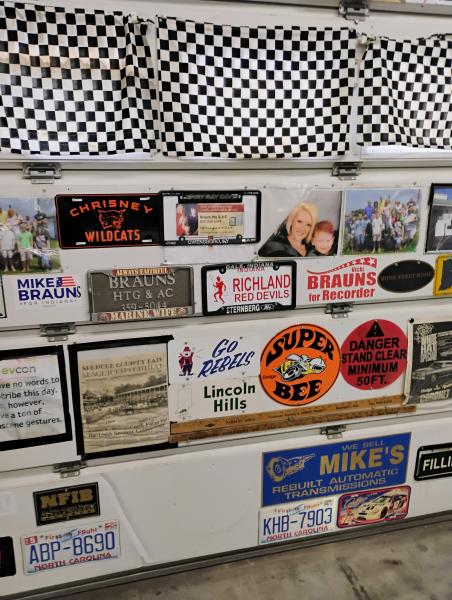
In the spring of 2026, three American Legacies Org, Inc. volunteers named Franklin Wike, Ruthann Wike and Michael Hamlet conducted an interview with Tom and Vickie Braun from Spencer County, Indiana. This interview was captured on video and audio recorders.
Following is the text of the audio recording.
*********************************
Tom: We have some of Elvis' jewelry that he actually wore on stage. We got it from Cricket Coulter. She was the fan club president. She actually was here, stayed a couple nights with us, and she brought the jewelry. And we bought some of it. Some of it.
Mike: That's awesome.
Vickie: Good morning.
Ruthann: How are you, maam?
Vickie: I'm all right. How are you?
Ruthann: I'm doing okay.
Vickie: Well, that's good.
Ruthann: It's a beautiful day, and the Lord let me get up.
Vickie: Isn’t that the truth.
Tom: Warren Bass is how I got those sun glasses. (Sun glasses that belonged to John Lennon of the Beatles.) He was written up this week in the paper, the local paper.
Ruthann: I saw that. Yeah. I was reading through it, figuring that it would have, that he was visiting you.
FTW: Okay, to get started here, for the record, I want you to give me your full name, both of you, and including spelling any names of any family members so that when it's transcribed, we make sure we get the spelling correct.
Tom: Okay.
FTW: And Tom, we'll start with you.
Tom: Okay. My name's Thomas David Brauns. This is my wife, Vickie.
FTW: Let's start with who is the oldest relative you remember?
Tom: Okay. Oldest member I remember is my great grandfather, John Henry Carver and Loretta Carver, great grandparents.
FTW: Okay and where did they live?
Tom: They lived in Hatfield, Indiana.
FTW: Do you remember any special times you had with them?
TB: Yes, mostly Halloween. She made popcorn balls, things like that. You'd go down there, they'd all have something little for you, but it meant a lot. So we visited them quite often.
FTW: Do you have any idea when they were born?
TB: He was born 1865, I believe. And she was more like 1870. He died in 1964 and she died in 1968.
FTW: Vickie, how about you? Who's the oldest relative you can remember?
VB: On my side or his side?
FTW: Yes, on your side.
VB: On my side? Let's see. I remember my great-grandmother.
FTW: What was her name?
VB: Her name was Myrtle Mae, like my mother, Myrtle Mae, and what was the last name? Wilhite.
FTW: Spell that.
VB: Wilhite is W-I-L-H-I-T-E.
RAW: How is May spelled?
VB: M-A-E.
RAW: That's how my mother's middle name is spelled.
VB: Yeah, it can be spelled several different ways. As a matter of fact, my grandma was Bessie Mae, and it was spelled like my mother's M-A-E, but her sister was Anna May, and it was spelled M-A-Y. So I guess I thought that was different. Anyway, yeah, and she lived to be 105. And, well, almost 105, just within a week or two. And then Grandma Bowen had, she ended up with cancer, and she died in the hospital. What was she, about 87? Yeah.
RAW: What was her last name?
VB: Bowen.
RAW: Spell. B-O-W-E-N.
RAW: What was your maiden name, Vickie?
VB: Gardner. G-A-R-D-N-E-R. Now, I remember them. That's about as old one as I can remember. I was born three months or four months before my grandfather's father died, and they said he held me. But that's about all I can remember. Or I don't remember, but I remember the story.
FTW: Are there any, and talking about remembering the stories, are there any stories that either one of you remember that other people told you about your ancestors? And I'm just going to let you think back and any ancestor at all, any interesting stories you heard about any of them.
TB: Grandpa Carter was a fisherman down at Enterprise. That’s what he did for a living. Of course, back when things were pretty scarce, you know. But that's what they did. They lived in Enterprise, Indiana, which is south of here, about five miles on the river. I remember stories of that. Relatives would come down there and visit. They'd say they'd see them coming across the field, you know. My grandpa would holler at grandma and said, get a chicken ready and start fixing dinner, you know. Yeah. They tried to get ahead of it a little bit.
VB: Do I remember stories they told? I can't remember. My memory's not great, but I remember stories myself.
FTW: All right. What are some of the stories you remember?
VB: Well, I remember grandma's two, her and her sister Anna May, killing chickens. And they had a blast with holding them around their neck and wringing their necks. And then they had a big pot of water and they dipped them in the water to pull the, you know, clean off the feathers. I don't know. I just remember, I remember those. Anna May's husband worked, lived in Evansville. And grandma, her husband just worked for the Green Thumb.
FTW: Which grandma?
VB: Grandma Bowen. He worked for the Green Thumb, did cleaning and yard work and house repair and things like that. Those are the only days I remember. I know he had a job. Well, yeah, they did. They had a job before. They had a little grocery store in where they call Avondale in Evansville.
FTW: Remember the name of the grocery store?
VB: I don't remember that anyone ever told me. I really don't.
FTW: Remember the time frame?
VB: It was during the...
TB: Depression.
VB: Depression era. And he gave too many people credit, so they didn't end up keeping that. But he did. He was really good. Then they moved to Newburgh area, and they finished out their lives in Newburgh. They had 12 kids. 11 were raised and survived. And there's... Two left out of the 12.
FTW: Can you describe the physical appearance of any of your relatives?
VB: Well, it's funny you should ask that, but Grandpa Bowen and Grandfather Gardner were both short people and very small in stature, not heavy at all. Grandma Bowen, mom's mother, was rather, she was a little large. But she was tall. So they had kids, and those kids, half of them were tall, half of them were short. It didn't. But her mother, Grandma Wilhite, was very short, shorter than I am now. Yeah, she was cute. She was a spitfire.
FTW: Is there anything you can tell us about why you mentioned one that had cancer? Any of your relatives, any medical issues that they had that led to their death?
TB: Grandma Burns died of cancer.
FTW: And what was her first name? Nana Mae.
FTW: Do you want to spell that one?
TB: N-A-N-A and then M-A-E.
VB: Same kind of May. That's why we have a, you know, Melanie May. Kind of carried it on. I don't know. Grandfather Gardner had ended up with lung cancer. He smoked his entire life. He worked in…
TB: Coal mines.
VB: Underground coal mines there in Newburgh and he always said in Newburgh where the coal mines were because he worked there and they would say that, the smarter younger people would say no there was never one there, he says I know there was one there I was in it. So yeah, that's just how it goes, you know, but they don't record everything. But as far as that, grandmother ended up with diabetes and I think that kind of…
FTW: Which grandmother?
VB: Grandmother Gardner I was talking about, ended up with diabetes and that kind of took her out, but she still lasted quite a while. How old was she, 85?
TB: 87.
VB: 87. So, yeah, that was still a long time with somebody that had insulin, you know, diabetes.
FTW: Tom, how about your family?
TB: The reason we're here is my grandparents met in Chicago. My grandmother was from here, maiden name Carter. And my grandpa, Fred Bronze, was from Iowa. And then during the Depression, you went to Chicago or a big city looking for a job. And they went out there and they both had jobs and they met. And then they wanted to move. And so they decided to move here, where grandmother was from. And they bought this farm in 1935. And my great-grandparents lived here for five years while they were working, paying for it. They got five years of that out of the way and they moved down here. And we're the fourth generation. We have our daughter and granddaughter living here now and that's, we go down to the sixth generation living here, I guess. So that's...
FTW: Descriptions of any of them?
TB: Well, Grandpa Brauns, he was about 6'3". Grandma Brauns was five-eight, five-six?
VB: Yeah, she was a little taller than I was. I am.
TB: Something like that.
VB: I'm not a was yet, am I?
FTW: Red hair, white hair.
RAW: White?
TB: Yeah, very well. I'm talking about the time I knew...
VB: No hair?
TB: Yeah. No hair. Yeah.
FTW: Who's this?
TB: Nobody. It's just a...
VB: Maytag advertisement.
VB: But I helped Grandma Bowen do laundry on those (wringer washer), and she took in laundry. And I have run one of those. I thought it was just the neatest thing. She was glad I would help her.
FTW: Any medical conditions you remember or remember about?
No response
FTW: Talk to me about this building and how you got started with these collections.
TB: Vicki was out helping Melanie in North Carolina. She lived out there, the youngest daughter, moving or something.
VB: Having a baby maybe?
TB: It could have been. Anyway, I was here by myself and I guess got bored. I had all this stuff in boxes and cabinets and so forth and didn't really have much on the walls at all. And I got started on it after work about probably 6 o'clock. And probably about 75% of what you see, I put up in one night. I got started on it and went crazy and ended up working all night until next morning, daylight. Well, I had to go to work after that. But I had most of it done out of the way. I didn't want it stacked around. I had it dug out. So the other 25% has been added here and there, but that's been 20 years ago or more.
FTW: Is he a workaholic?
VB: Well, no more. Yes, he's a workaholic. That's not even the word for him. It hasn't been 20 years. Carter's 19. So it's been, yeah, that's when Melanie was having him.
TB: Okay.
VB: When I called, just because I called a check on him because I'm out there, and so I just called. He was so proud of himself. Oh, you're not going to believe what the garage looks like. Oh, I put up a lot of – he didn't say garage. He just said, I put up all this stuff, you know, all this memorabilia, and I'm going, you didn't put any of that in my house, did you? And he says, no, no, no, it's out in the garage. So I thought, oh, boy.
FTW: When did you start collecting memorabilia?
VB: We have all along.
TB: Yeah, 18, probably 18, 19 years old.
VB: Yeah, it might have been a little after that because there's a lot of stuff that we kind of got rid of that I didn't want to get rid of. It just left. You know what I mean. Okay. So it was a little, it was probably after our kids, our grandkids were born, that we really, we really did get into everything.
TB: That’s when it increased.
VB: Yeah.
FTW: You mentioned something one time about a famous ancestor that you're related to. Who is that?
TB: General Sumter. Fort Sumter. That's... I don't know if we're famous or not, but Hatfields and McCoys. My mom's Joanne McCoy, and we have cousins out there. Distant cousins.
Mike Hamlet: Were they from Appalachia?
TB: Well, no, my mom and McCoys have been here since 1815, so that was even before the feud. Nearest we can figure we're distant cousins there.
MH: Yeah, I worked with a Sammy McCoy in Owensboro.
TB: Yeah, that's a cousin. That's the second cousin to me. He'd be around 60 years old in that area.
MH: I think he passed away.
TB: Well, he's in real bad shape if he didn't. Wait a minute. There's two Sammys, an older one and a younger one.
MH: I'm 68 and he was probably 65 now.
TB: Yeah, that's the younger one.
FTW: You have a photograph of a building and it says Bullocktown. It's some kind of a general store. What's the reference to that?
TB: We rode our bicycles to that when we were kids and it's about four miles north of here at Bullocktown.
VB: Bullocktown Road is that Road over there. I had a famous relative.
FTW: Who was that?
VB: Francis Scott Key.
RAW: Oh, yeah?
VB: Oh, yeah.
MH: That worked out, yeah.
VB: Yeah, kind of, yeah. I didn't know that until he researched it. Tom researched it and found it. figured it out and Sarah and this Gardener lady, but yeah, he did that. And now when I hear that, that song, it kind of means a little bit different. Yeah. So...
RAW: That's pretty neat.
VB: Yeah, it is.
TB: Francis Scott Key had Gardener grandparents and that's what's heard. Okay. But I think, six great-grandparents, I believe, for you.
VB: I think that's what we said. You said six once before, but I don't know. I think we keep going over it. That's hard to figure out, keeping generations.
FTW: Tell me about your life as far as some of the goals that you have accomplished that really makes you feel proud.
TB: Well, just having your own home, you know, buying it from the family.
VB: Kids.
TB: You know, the kids, our kids are doing well, and that's the big thing there.
VB: Grandkids.
TB: We have three.
RAW: Three girls?
TB: Two girls and a boy. Two girls and a boy, yeah. One boy is getting ready to move in about a mile from you.
RAW: Oh, really?
TB: Yeah, Michael is. He's already bought the land and working on it there.
RAW: Where?
TB: Okay, behind you there, Parker Road or Beren Road, whatever you want to call it. Get on that and go north.
RAW: Billy Goats.
TB: Yeah, get on that and go north.
VB: It looks like a good ground for Billy Goats.
TB: Down to the bottom of the hill. And you can either turn right and get on Highland Road, or you can turn left and go up just a little bit. The first place on the left is just a driveway and the starting of the house there.
VB: Yeah, it's got a little fence.
RAW: And so they built a basement and lived in it and then built on top of that?
TB: No.
VB: No, there isn't anything but a little cabin, like a hunter's cabin. That's what this man built, and that's what's on it right now.
FTW: You said it's on Highland Road?
RAW: No.
TB: It's off Highland Road there. It's on the Hutchinson's, you know, where Joffrey Huston used to live. Kenny Decker. I mean, Maurice Decker.
VB: I don't know any other people either. I just know where his place is.
RAW: Yeah, but... Yeah, if it goes over the hill, the billy goats, where all the big, steep hills are, is what you're talking.
TB: Yes, yes.
RAW: And before you go out on Highland, and there's a curve right there on Highland, where there's a log cabin up here that has been built, and then down below at the bottom of the hill... I don't even know what kind of a structure that is.
FTW: The building next to it is the son of the guy that built the log cabin. Unless they've sold it.
RAW: Okay. So I think I know where you're talking about.
TB: Yeah, you have to actually turn left on that gravel road and go east, or go west. Yeah. And it'd be the first driveway to the left, and it's up on the hill, way up on the hill there.
FTW: Okay, I know where it is. Okay. Start telling me some stories, favorite memories of your life together, of your family.
RAW: Before you get into that, when were you guys married? How old were you? How did you meet?
VB:We met in the summer before we went for freshman, didn't we?
VB: Before we went to high school, yeah, summer of freshman year.
TB: Swimming pool at Rockport, I guess, wasn't it?
VB:Yeah.
TB: Okay.
VB: I told my daughters that we went to Nashville one time, and we had my girls and their friends, and we were just, well, how did you meet Tom? Well, here's my story. I went to the Evansville … Sorry, mean Rockport swimming pool.
TB: Watch out.
VB: With my girlfriend. And I saw this real tall, lanky, skinny guy jumping off the high dive. And I just, I liked him then. I like that guy. Who is that? Well, then I found out. That's how we met. That's how I met and how I decided that's what I was going to do. But I don't know if, you know, he came along.
FTW: How did he propose to you?
VB: Oh, we just talked about it all the time. I mean, we just talked about it. This is what we were going to do, and this is our plan. We're getting married, and blah, blah. And we went together and picked rings out, and then we picked them up, and I think he gave it to me at Taco…
TB: Kid.
VB: Yeah, a restaurant. We were just sitting there talking, and then we gave it. Yeah, I put it on there. But it was our favorite place to eat. It was before Taco Bell and all those other places.
TB: I was 18, still 18. She was 19. But we're just a month apart, so it was in that month.
FTW: But you married an older woman.
TB: Yes.
VB: Well, he does all the time, so that's what I like. What year? Well, I don't know. Ask her. She's older.
RAW: What year did you marry?
TB: 1975.
VB: Yeah, 1975. I was going to say, but I didn't know. We graduated in 74. We waited a year and got married in 75. And then had Melissa in 77, the first.
FTW: What's the first vehicle you ever drove?
TB: Ever drove? Probably dad's car. I was about 12, I guess.
FTW: What was it?
TB: 53 Studebaker.
FTW: What kind?
TB: I can't remember. It was the lower model. I can't remember the surname of it.
FTW: What was the first vehicle you ever drove?
VB: Probably the first vehicle I ever drove was a Chevy Nova three-speed on the column that was mom and dad's. It wasn't mine, but that's what I learned on with my sister.
FTW: Remember what year it was?
VB: Was it 70? Yeah, 70. It was good for them, but I hadn't driven anything. He grew up driving farm trucks and, you know, his dad's vehicles, motorcycles. He always had a motorcycle. That was what was exciting to him.
FTW: Tell me about the motorcycles.
The first one was a Harley.
FTW: What kind?
TB: A small one.
FTW: How small?
TB: Maybe a 65cc. Might have been a 50. I can't remember.
FTW: I believe it was a 50.
TB: 50. It had the gear shift on the handlebar. Three speed on the handlebar.
FTW: And where did you graduate to after that?
TB: I went to a Honda 90.
VB: We kind of got stuck on the Hondas then. That's what we've had since.
TB: Went to a 350 and then went to a 554 similar and then went to a Goldwing.
FTW: Do you still ride?
TB: No, no riding anymore. We sold the Goldwing about, what, five, six years ago? Something like that.
FTW: Why'd you quit?
TB: She didn't want to ride anymore because we had a couple of close calls on the highway there.
VB: He had back issues, too, and it was a little bit wobbly, and I was a little worried that he would get hurt. So I said, no, I can't ride because I didn't want to get hurt, too. At our age, we can't get hurt.
MH: We don't bounce like we do.
VB: No, we don't. Absolutely not. In the last five, six, maybe more, yeah, you just don't. He'd had... two back surgeries. Well, you had four all together, hadn't you?
TB: Five.
VB: Five, okay. But he had two right together, and they were both like six, seven-hour surgeries. So I just didn't think it was a good idea.
FTW: What's the farthest trip you ever made on a motorcycle?
TB: St. Louis, I think. It's about the furthest.
FTW: And both of you are on it together?
VB: Mm-hmm.
FTW: Goals for the future?
VB: Do we have any?
MH: Wake up tomorrow.
VB: Yeah, that's a very good one.
FTW: What are some of your happiest memories? Childhood memories?
VB: Childhood. I just, you know, playing with my family, my brothers, grandmas. We've always went down there. Grandmother and grandma live just like catty-corner from each other. So we run back and forth either one. So we were just all excited about that. Had lots of cousins. And then I had two aunts and one uncle. And they were closer to my age and we all, you know, we were just, there was always a group there. We always had a baseball team.
FTW: How many brothers do you have?
VB: I had two brothers. They're both passed.
RAW: Was that just the three of you or?
VB: Just three of us.
RAW: What were their names?
VB: Gregory and Donald Gardner. They both had cancer and they were both 55 when they died.
FTW: Did they have children?
VB: Donald did not. He had a woman that he was married to for a long time, and then they separated. But they had two, and a boy and a girl. And so he kind of raised them from four or five years old. And one of them lives in his own house. The other one is a retired Army ranger. And then Greg has three. Chrissy.
TB: Four.
VB: Four, yeah, four. I knew I would say that, but two girls and two boys.
FTW: Are there any stories you can tell about your brothers that the children would be interested in hearing?
VB: Probably have told them to them. Because I try to keep their memory alive with stories about them. I remember when we lived in Evansville, Donald, you know, the lady across the road that's before cigarette smoking was so bad. And she smoked a cigarette and he wanted to smoke a cigarette. So mom said, okay. My dad smoked anyway, so... I got a picture of him sitting there just looking real cool, smoking his little cigarette. And they all gave him a hard time. We teased him about that. I just remember that. I remember playing, telling them about playing in the rain when you played, when it thundered and lightninged and it, you know, the rain poured down and we had concrete roads and driveways so it would bounce up.… just things like that. Sitting in the kitchen one night Donald or Greg looked out the window, the kitchen window, and that's where the driveway was and the truck was moving. So they didn't get it in gear or slipped out of gear or something. And we were all yelled about, Dad, Dad, the car's moving. You know, just things like that. We had lots of fun, fun. We played. We didn't do baseball teams and basketball teams and all that. Not that we had anything against it. It just wasn't that readily available.
FTW: What house was the town in?
VB: Evansville. Out by Angel Mounds, actually. Now the road goes through there.
FTW: What kind of house was it?
VB: Just a three-bedroom brick home with a basement. Dad worked for the railroad in Evansville.
FTW: What kind of work did he do for the railroad?
VB: He was a computer... just operated the computer and directed the trains.
MH: Dispatch? Dispatcher?
VB: Kind of like that. They would route the route for them when they got what was coming. Actually, when I was, I saw a, this would be something, I saw a graduation thing from, what was that? What's that college that does, it's in Evansville.
RAW: Ivy Tech.
VB: Ivy Tech. And he was like one of the first, on graduates for computer school. I mean, they didn't have computer that much back then, you know, and that's what the railroad used was the computer.
RAW: We were talking about the computers at that time took up a whole room.
VB: Oh, yeah. Yeah, and he would bring home, they had these cards, you know, those little punch cards. He would bring those home at Christmas, and we would fold. Of course, they're long, and we would fold the end of it, and it would be a point, and then we'd put it around a wreath and spray it gold, and Mom made wreaths and gave those, you know.
FTW: What era, time-wise, was that?
VB: Well, yeah, probably 60s. I mean, Dad worked from there at the age of 15, played basketball in high school, and worked for the railroad as a luggage guy, you know, putting the things on the luggage out in Evansville. Then he also went to the service, and graduated in the Navy. And he came back from that, and they held his job for him at the, for the L&N. It was the L&N Railroad at that point. And it changed so many times after that in recent years, but yeah.
FTW: And what was his full name?
VB: Robert Whitcomb Gardner.
FTW: Tom, how about your dad?
TB: Dad... Was a teacher and principal. He was principal over here at Luce for 30 years. And mom drove the bus, school bus. So I did that.
VB: After she got you guys raced a little bit.
TB: Yeah.
VB There was five of them.
TB: About 17 years.
VB: Yeah.
TB: Anyway, that was most of his career. He did teach a little before at Richland, before he got the principal job. And a little bit at Rockport. before he got that job and then stayed there until he retired at Luce.
FTW: What kind of classes did he teach?
TB: It was mostly history and English.
FTW: Okay, so that's where you got your interest in history?
TB: Yeah, I think so, probably a bit of it.
FTW: And what was his full name?
TB: William Frederick Bronze and Margaret Joanne Bronze, his mom.
FTW: Did she work outside the home?
TB: Did at the courthouse, Spencer County Courthouse, for a while until the kids came along. And then she was more or less a housewife and school bus driver.
FTW: What did she do at the courthouse?
TB: She worked at the county extension office. That's when it was up in the courthouse. It's not now, but it was.
VB: Do they even have a county extension? I guess they do, yeah, for the farmers. Yeah, used to do it for the women, and we'd have, she belonged to the women's group, the Ebenezer group, and I joined that later too, but she was a member a long time in that.
FTW: Do you farm the land yourself, or you let others?
TB: I rent it out to, this farm here rent out to Steve Lindar down the road here.
FTW: Did you ever farm it?
TB: Yes. I was just a kid doing it. My grandpa and dad had the farm. We had another farm on down the road north here, and eventually over by Sand Ridge, where we lived, too.
MH: What kind of crops did y'all grow?
TB: Beans and corn, mainly and hay.
MH: No tobacco or anything like that?
TB: No, I never did do tobacco.
VB: Did you ever have to go out in the field, like your sister said, and cut weeds?
TB: Oh, yeah. We had to cut weeds back then because the chemicals didn't, we didn't have those. So we went up and down every row, you know, with a weed hook.
MH: It's nothing like it is now.
TB: No. And cultivator spent a lot of hours on that and the disc and plow and all that, you know.
VB: Now you can get a field like that over there done in half a day.
TB: Yeah.
VB: And you don't even have to be driving the tractor anymore.
MH: They got the GPS on the tractor?
VB: That's what I mean. Yeah.
FTW: Your grandparents, give me some names for your grandparents, full names, and what kind of work they did.
TB: Okay. Frederick August Bronze was my grandpa. Of course, Naomi Carver, we talked about, grandma, they farmed their whole life, except for Chicago Depression.
FTW: Except for ….
TB: In Chicago during the Depression. Yeah, they worked in the factories.
FTW: They worked in the factories.
TB: Yeah, and then farmed the rest of the time.
FTW: Okay. And yours? Well, Grandma Bowen took in laundry, but she raised 11 kids, so that was her job. I mean, yeah. She also had a handicapped son who was born that way. We think she always said it was because the doctor didn't make it there in time. I have no idea, but none of the other kids out of all of them were. One of them was four years old and got pneumonia, and that's the one that passed. Um, but anyway, net, uh, grandma Bowen worked at home. She also ran the grocery store when they had that earlier, you know, she helped do that. Um, grandpa Bowen, I told you what he did. All I know is what he did. I'm sure he did other stuff. I just, you just didn't hear stories about him like you did all the rest of them. But, uh, grandfather Gardner worked at, um….
TB: Coal mines.
VB: Well, he worked at coal mines, but before that he worked where they built trains and things like that, International Steel in Evansville. I think he retired from there, actually. My aunt, his daughter, my aunt, was a nurse for International Steel, and they kind of worked together at that point. And then Grandmother Gardner, she worked... A little, you know, but what she did was, do you remember Pafflin's Lake? Do you remember that? She was the little lady that sat in the little building and took your money. She was the only one that ever worked that one, that job. So if you went in there, you saw her. But, yeah, that's what she did.
RAW: I never was there, but my sister was.
TB: I can remember her going there.
VB: And that was her job, and then they were all, very active in the county, the community, grandmother and grandpa Gardner were. Grandma Bowen wasn't so much, but they were Odd Fellows and Rebecca's and all kinds of, you know, youth foundation. It wasn't Methodist, wasn't it?
TB: For a while was there on the hill.
VB: But anyway, they were very active.
FTW: Who was Roy T. McCoy?
TB: He had, believe it or not, he had an appliance place in Midway back in the day there.
VB: It's funny how things run and intermingle with what your life is.
TB: It was mixed in with some LP gas and hardware store type deal and then his son-in-law took it over and moved it to Boonville later. That was a first cousins of my Grandpa McCoy. Roy T. was.
FTW: Let's go into your great-grandparents' full names and anything you knew about their work.
VB: I don't know too much about their work, do you?
TB: Okay, William Daniel Brauns was my great-grandpa on that side. And his wife was... Catherine. Iowa Catherine.
FTW: What was the first name?
TB: Iowa.
VB: They lived in Iowa.
TB: They lived in Iowa. Iowa Catherine Waymire was her maiden name.
FTW: Spell the last name.
TB: W-E-H-M-E-Y-E-R. Wehmeyer.
RAW: Spell Catherine.
TB: K-A-T-H-R-I-N-E. I have a sister, Kathrine.
RAW: Spelled the same way?
TB: No. There's a C.
VB: There's a C.
TB: I don't know how that happened, but it did.
VB: I could guess.
TB: They have three sisters and one brother. One sister, a teacher, retired, just retired, and then she died.
RAW: What was her name?
TB: Connie Jo, J-O, and, of course, Brauns Freeman, the last name now.
RAW: And the third sister.
TB: It was Catherine.
VB: The third sister is Maria, isn't it?
TB: Yeah, the third sister is. Catherine, then that, again told now, is second sister. And then Maria Michelle Brauns Gantner is third sister. And then my brother is William Kevin, Brauns.
RAW: With the two sisters, their last names, can you spell their last names?
TB: Okay. Well, Freeman is F-R-E-E-M-A-N, just like it sounds. And then Ginto is G-U-I-N-T-O. And then Gantner is G-A-N-T-N-E-R.
FTW: Did you ever serve in the military?
TB: No. No.
VB: That's a story.
TB: No. I got drafted to go to Vietnam. Senior year. The first year, just getting into the senior year, I got drafted. There was only two of us out of the whole high school got drafted. And by Christmas, they called the war off. I got a letter. Said you don't have to go. They did tell me I had to go to Louisville. You'd be ready to go see if you get out of high school. And the letter I got around Christmas, that was a Christmas present.
VB: That was a big Christmas present.
FRW: Could ask how old you are.
TB: We'll be 70 here in about three months.
FTW: You guys are still young.
RAW: Babies.
VB: Thank you. I'm going to keep feeling that too.
FTW: Now, you said military, that was a story that you were referring to.
VB: Yeah, yeah, to get that. We knew he was going, and it was like, ah, but yeah.
FTW: What about your father? Did he serve in the military?
VB: Yes, he was a Navy man, submarine, actually. He liked the submarines, and he was an electrician on the sub. And his brother, Charlie, went into the Navy, too. It seemed like all of that group around in Newburgh all went Navy. I don't know if they just all talked to one another because they were big buddies. All their buddies, because I would go to Dad's and Mom's.
MH: It must have been a really good recruiter.
VB: It might have been. It might have been it. I don't know. Because... When I'd go to his class reunions with him, you know, I'd talk to the old guys around there, and they all were Navy guys. You didn't hear too many other. Now I hear a lot of Marine, and I hear a lot of Army, but, you know.
FTW: Any of your brothers, siblings on either side, serve in the military?
VB: My brother did. Yeah. He was Navy too, wasn't he? Yeah. But he didn't go the entire time. He just had some issues and they let him out.
RAW: Did you have any brothers in the military?
TB: No. Grandpa McCoy was in World War I. He was in Germany. I do have a, I guess you call it a souvenir from that. When he was over in Germany, he shot an officer.
FTW: His or the enemy?
VB: The enemy at that point. The gun's German. So he figured it was. It might not have been.
TB: So when he did, he picked up his, he had a long barrel Lueger, he picked it up, and we have it.
VB: He brought it home.
TB: He brought it home from Germany. That's back when you could do that, and they didn't think anything about it.
FTW: Do you have a picture of that?
TB: I've got the real thing if you want to see it.
FTW: Yeah, I'll take a picture of it. Before we leave, we'll take a picture of it.
TB: There's probably a picture in that book there, but yeah, we can see it.
FTW: Okay. And the full name of your Grandpa McCoy?
TB: James Burke McCoy.
FTW: Okay. And do you know where he was born?
TB: Around Richland. Yeah, but actually east of Richland a little bit.
FTW: Do both of you guys have family tree charts that are filled out? Do you have a photograph of the family tree charts?
TB: Yeah, I did.
FTW: Before I leave, I want to get a copy of the photograph of the family tree charts.
TB: Okay.
FTW: And the reason, I'll explain the reason when we're off camera. Mike, questions from you.
MH: I'm at a loss this morning. I got choked too many times this morning. My brain's not good.
FTW: Ruthann? Oh, I've been asking.
VB: Yeah, she has been.
RAW: Well, yeah, why not? Any special memories of Christmas as a kid? As a kid? Get anything special for a Christmas present?
TB: Was it a real tree?
VB: Yeah, those were real trees back in those days. Yeah.
MH: Did you go cut it or buy iy?
VB: We bought it. We bought it from a tree farm up the road there. So, yeah.
MH: Did you ever go cut a Christmas tree?
We have. We have.
TB: We have.
VB: For somebody, but yeah. Yeah.
MH: I remember we cut a big one down and cut the top out and the branches were this far apart and we looked at it and we had to take a fishing line and tie the branches together.
VB: Oh yeah, they were so ugly when they were like that because dad and mom always had, you know, that kind of tree.
RAW: So that's your memory as a child.
VB: I remember my grandmother, Gardener, always had the silver tree. And we would all sit in the Front room. You didn't go in the front room. That was just a special room. I mean, you could go, but none of us did. We didn't play in the front room. We played in the middle room. And she had that light that turned around.
RAW: So did my grandmother.
VB: Yeah, and the silver reflected. It was really pretty, but she always had that every year. And if the light didn't work, Grandpa fixed it. Yeah, I remember that. Grandma Bowen, she always had a tree, but with 11 kids, or 10 kids all having kids of their own, it was crazy. Fun, but crazy. And in her latter years of all of us being there, the kids, she had a single wide trailer, and we all got in there. And she bought every one of us a gift every year. It might have been a pair of socks. It might have been a hanky. It might have been just a silver dollar or something like that. But she had a gift for all of us. Her kids, you know, her own kids and her grandkids and their spouses. And she was not a rich person.
TB: She probably worked on it all over a year.
VB: Yeah, she did. She bought them. all year you knew she was doing that so that's kind of neat. I mean she was on welfare because grandpa couldn't work or didn't work much, but after he passed then she was even, you know, it was even harder for her.
So and she still had Bobby, which my was my uncle who was handicapped and he was about yay big, big, heavy set. He barely walked a lot, much, but he kind of waddled, but he had his little matchbox cars, and he put them on the table. And there might be 40 of them, but he put here, and he'd move that one up a little bit, and then come and move the next one up, and then he'd walk back here and move the next one up. And he went around the table all day long. That was his thing to do. Yeah, but when grandpa died, I watched Bobby because I was just at the age I wasn't, they didn't take me to the funeral home that much and let me go and bring back. But I watched Bobby and I stayed with him and we looked at a book together, like a Christmas catalog, stuff like that. He loved that. He just, he'd point and I'd tell you, say what it was. And he never spoke much at all. He might yell or whatever, but after all, like it came up to the house and he sees me out in the yard. as they're driving up, and he goes, Vicki, and that's the only time we really ever know that he said anything, that we understood, that was a word.
RAW: That you understood.
VB: Yeah, that anybody understood.
FTW: Did any of your family members on either side talk foreign language?
VB: Well, an uncle, and aunt did, his Uncle Roy.
TB: He was Italian.
VB: He came from Italy. He brought her back with him from Italy.
RAW: After the war?
VB: Mm-hmm. He met her during the war, yeah.
FTW: Do either one of you have information on the first ancestor coming to this country?
VB: We do, yeah.
TB: Yes.
FTW: Tell me about it.
TB: Let's see.
FTW: And where they came from?
TB: Came from Germany. The one I know about it. About, around 1850. And they went through St. Louis and up to Iowa. That's where they landed.
FTW: And which branch was that?
TB: That was on the Brauns side.
FTW: Okay. That would make sense on the German.
TB: And then McCoys came from Scotland and... They got here... late 1700s. Actually, to this area was 1815. That was William McCoy, Sr. They landed out here north of Richmond about three miles on Pigeon Creek. On the way, Grandma died, and they had like eight kids he brought by himself.
RAW: Oh, my.
TB: And one brother stayed over around Henderson, in between Henderson and Owensboro. One brother McCoy's over there. McCoy's, you know, they came from here. Sam.
MH: Yeah.
TB: But there's other McCoy's over there. My fourth-grade grandpa's brother, Thomas.
MH: Yeah. Around Sebree in there?
TB: It'd be, yeah, it's east of Henderson there. Southeast a little bit. Rockport, Kentucky.
MH: Yeah. What's the name of that? I used to hunt off Audubon Parkway over there. Yeah. Lots of Keatche’s there, too. I used to work with Bill Keatch. I used to work with him. Huversville.
TB: Probably in that area there. When they stopped in Nelson County, Kentucky, both the brothers did and lived there for a little while before they came on. Came on to Henderson and my fourth grade grandpa crossed at Troy. Came over from Troy and then ended up north of Richland on Pigeon Creek there.
FTW: Where'd you guys go on your honeymoon?
TB: Florida.
FTW: Where?
TB: Daytona Beach.
VB: That was the place.
RAW: Was it the first time you...?
MH: Was when you could drive on the beach, I don’t think you can drive on the beach anymore.
VB: No, probably not. We…
FTW: What was your favorite romantic date that he ever took you on?
VB: I don't know. Do you? Was there any time that you thought, yeah, honeymoon? That was about it.
TB: Taco Kid, huh? Yeah. Yeah. Yeah. That sounds so goofy now, doesn't it?
FTW: Tell me about your interest in music. How did you get started on that?
TB: Well, we both always had that. We always had the radio on, dating and so forth, and we were always with it.
VB: Buying CDs and...
TB: Yeah, and Olivia Newton-John, Elvis, Cher, all that stuff. That was our era. We just kept going from that and never to get out of that too much.
FTW: How did you get started inviting people in for music?
TB: I guess Bill Haley's Comets... Warren Batts is the last living member of that. And he came into the store over on the highway in our shop and bought a refrigerator. And he had a lady with him, a girlfriend there. And he bought it and he told me where he was moving into, which is two roads over here. He made a lot of money, but he also spent a lot of money. So he wasn't rich by any means, but... He bought that, and they were getting ready to walk out the door, and the girlfriend says he used to be a lead guitarist for Bill Haley's Comets. I said, yeah, and I'm Santa Claus, too. And she said, no, really. And she said, look at that van outside. When I looked out there, the van had Bill Haley's Comets on the side of it and so forth. And I said, okay, come back in here, you know, I want to talk to you. So then I said, you ever do any private shows? And, uh, he said, yeah. So, uh, I got him to come over here and I just invited neighbors around here close, you know, of course they, you know, I thought it was great and I couldn't believe who he was and so forth. And, um, and he got hooked up with, uh, Elvis’s, one of his illegitimate sons, he’s got more than one, Kenny Presley, but he's Kenny Presley's only one that really had the talent and they started performing some together and then he got...
VB: they wanted to practice here.
TB: Yeah they're practicing in here and they had the band and you know the Duke boys and uh a guy named Stick Davis. Been in here. You've probably heard of him. He was with Pure Prairie League, and he was B.B. King's bass player for 10 years. He's got a whole list of credentials. He was in the band. Bob Green from Duke Boys. Danny Erkman, which opened for Johnny Rivers. He was the drummer. I think some of the others there, but anyway, they had a heck of a band, you know.
MH: You all like music, do you like to dance? Like a dance club or anything like that?
VB: I like to dance. This one, I threatened him for it at prom, high school prom, and said, you will dance with me that night. It might be the only time you ever dance, but you will. Okay, okay. I had power then, but...
MH: The power of music.
VB: Yeah, that's right.
TB: Well, they also teamed up with a guy named Steve Crews, which… There's three guys in the world that Rod Stewart recognizes that he could probably send out. You might not know that it's not him. He's one of them. He's actually McCoy's cousin to me.
MH: Oh, wow.
TB: That's the reason I know him. But he's been in here several times, too. And I had neighbors come over on him and Warren was playing for him. And what's her name down the road here? Steve's girlfriend. Angie.
VB: Angie.
TB: Angie did a video of him and sent it to her daughter. And the daughter sent the message back and said, where in the hell are you? She thought it was Rod Stewart.
FTW: Hold that thought. I need to cut this for a battery. I need to change off the battery.
Oh, wow.
TB: But he was good. He did it. He's a computer genius. He's a... What he did is Steve Crews, Rod Stewart.
RAW: How do you spell the Cruz? C-R-E-W-S. Okay, I didn't know if it was that way or with a U-Z or what.
TB: There’s a picture up there of Stick Davis when he came to I&M, Elvis’s son and two of our grandkids several years ago. Yeah, Steve Cruz...
MH: It's amazing what you've got into here. It really is. I mean, that's a lifetime of collecting.
TB: Warren Batts, we've met so many people and talked to so many people. I've talked to Louise Harrison and the Wizard of Oz, the last munchkin. Jerry Marin was his name. He was over here visiting Warren. He comes walking in with a picture up there of the Wizard of Oz. He was a lollipop guy that gave the lollipop to Garland.
MH: Yeah, the lollipop kids or whatever.
TB: Yeah, he comes walking in with a signed picture, you know, Jerry Marion signed, and he gave it to me for my birthday. Happy birthday to walk in, and he knew about it. And up there behind that jersey is a suit coat that Warren wore when he played for... Queen of England, and all kinds of special events. And for some reason, he gave that to me. We just put it in the shadow box there. There's a record over here that he made, and Reba McIntyre was 16 years old, unknown, and sang backup for Warren on that. And Warren had the record walking down the street in Nashville, and he ran into Willie Nelson. They didn't have anything for him to sign, so he just signed the cover and the record. His name's on there. Willie Nelson's autograph with Reba McIntyre singing and Warren Batt's singing lead on the thing. It's all on that one record.
RAW: Wow.
TB: There's a few things that are worth something in here, but most things are not. Something you'd probably like is that license plate that they're like. If you read it or not.
MH: Yeah.
TB: There's Kentucky on it. You know, it's a Bicentennial, license plate, Pepsi.
MH: Let's see which one you're talking about.
VB: On the box there? The one had a gray box there.
MH: Oh, okay. Yeah, I see it now.
TB: Yeah, that's something you'd probably like there. I've also got something from Owensboro. I'll show it to you here in a little while. It's way back.
MH: Well, you know, the bluegrass, see how my brother married, the Nancy’s that live across from Bill Monroe's farm there on 62. And Owensboro’s proclaimed to be a home of the Bluegrass View. That's where Bill Monroe's house. So actually, Terry, one of the beds of his granddad that he slept in is in Bill Monroe's house that they go through the museum and go up there and go. They had that Jerusalem Ridge thing there. They go up there and, you know. But Terry came up there and I was up there with Willis and all these blue viewers. They had a little booth set up there showing about them. And Terry walked in. And then everybody came up and started talking to him, and they were like, how do you know this guy? I said, well, you know, his wife, her sister married my brother, you know, and he's had that farm across from Bill Monroe's farm. That was his granddad and his great-granddad, kind of like y'all has through the family. So a lot of the stuff up there came from Terry’s great-granddad.
FTW: Tom, you got a photograph of three guys, William Daniel Brown, seniors in the middle. Yeah. The other two are holding, well, all three of them are holding shotguns. You got any information on?
TB: Yeah, just two buddies my great grandpa had there. And I don't know the names of them, I don't think.
FTW: Okay.
TB: But I know that one in the middle is my great-grandpa. William Daniel Brauns.
VB: Were they on... Did they just pose for that? Were they posing for that? I mean, I've seen the pictures.
TB: It's supposed to have been a funny thing there or whatever, you know.
FTW: Okay. Were any of your, either your dad, your great-grandpa, great-grandpa, any of them hunters that you know of?
TB: Yeah. Great-grandpa and grandpa were. Dad just did some until he got away from the house there and got into teaching. They quit hunting.
FRW: Okay. Any idea what types of animals they were hunting?
TB: I think mostly rabbit hunting.
FTW: Okay. Did you ever do any hunting?
TB: Yeah, I was a kid pretty well, but never did after we got married.
VB: You didn't do much of any of that. None of your, yeah.
TB: It was mostly...
VB: Not when I compared it to my family.
FTW: Tell me about your family.
VB: Well, I don't mean that. I just mean mine were just, they went hunting. I mean, they really went hunting. Squirrel, rabbit, deer, elk, whatever. Went to Missouri. My uncle lived in Missouri. They had a place there. Went there.
TB: They went down to the Elvis’s state.
VB: Yeah, they went down to Tennessee. They shot like, what is it, 12?
TB: They don't have any limit down here, if you can believe that.
FTW: What?
VB: Deer.
FTW: Okay.
VB: Brought them back, and they left them for my son to clean all of them. He didn't like that, and he didn't do all that. So, yeah.
TB: Our son, Michael, does a lot of hunting.
VB: Yeah, and my brothers and my father did, and his brothers and my cousins and all of them are all great white hunters, as we called them, because... It interfered a lot of times with when you wanted to have family dinners or whatever. They were hunting.
MH: Thanksgiving. It's that fall thing.
VB: Yeah, that's right. And a lot of them had birthdays during that time. Yeah. But yeah, they were big hunters.
RAW: They'd celebrate their birthdays out hunting.
VB: Yeah, that would be their thing to do. My dad used to say about my brother and Michael, My gosh, he said, they could hear you coming 10 miles away. They were so noisy. Now Michael can sneak up on you and you don't know he's there. So he learned something. Yeah. I remember that was, it brings a memory back of my brother, Donald. He and some boys we were living by, this lady had five boys and they went hunting. They took their guns. I think it was just a BB gun or an air gun, something like that. Anyway, he used it and put the end of it down in the mud, and it got mud. And when he shot it, it came back, and it hit him. He almost went blind, but it hit him right in the corner of the eye. It made his eyes... bloodshot like all the time especially on that one side and years later when he was ready to do driver's ed the driver's ed teacher called my mom and dad said this boy's on drugs because his eyes were bloodshot all the time but it was just the damage of the eye yeah lucky he didn't go blind.
TB: I didn't say anything about my grandmother McCoy. She was Erwin from around here, and Erwin's came here about 1815 also. Her name was Emma Mae Erwin McCoy.
MH: So Mae was a middle name for both of y'all's.
TB: There were five or six grandmas…
VB: I think we figured out five grandmas.
FTW: That one was M-A-Y or M-A-E?
TB: M-A-E.
FTW: Okay.
VB: We picked the M-A-E because it just, that's, you know.
FTW: Do you know if you have any May surname family members in your genealogy?
VB: I don't know of any. Typically, the middle name came after the name of a relative, be it a first or last. Usually, it's a last name.
VB: Yeah, because we did Joey McCoy, that kind of thing.
TB: Yeah, we got a grandson that's Carter McCoy, Duddy.
VB: But we chose that. But I don't know of anybody else before us. That have the last name of May. Yeah, yeah, I get it.
TB: We got three.
VB: Did we have any relatives with the last name of May that we know of?
TB: No. I don't.
VB: In any research we've done, I don't think so.
TB: No.
FTW: Okay. Who’s on the horse?
VB: His dad, I think.
TB: Yeah.
FTW: Who's on the horse?
Bill's on the horse. His dad.
TB: Should be on the back of every one of those pictures as an explanation of who it is and possibly a date.
RAW: There's another picture behind it.
MH: I've got these old pictures from Mott's family. Who is that?
VB: I do, too. Yeah, I do, too.
FTW: All right. Well, I think that'll pretty much cover it for today. I'll spend some time in photographs, and I'm sure I'm going to have a lot more questions for you.
TB: I've got a music book. It's about this thick. It's got all these guys we're talking about. A lot of history. Now there's a guy that plays not too far from Frank and Ruth that worked for Gibson and he made the guitars. His name was... it’s on the music that I have. Our secretary does some work for us on the books. That was her uncle, or greatuncle. I think the last name... Yhe last name was Fuquay, I think. He was a builder, designer for the Gibson Guitar Company. He got some kind of award, and that's what I have is a story on that picture of him. He's from Newtonville. He has a brand new address, of course.
VB: Really, both sides of our family had lots of music history. We just didn't pick up any instrument. Just listening is how we found it. I remember my brother wanted to play one of those, what is it? Fiddle? No, it's not a fiddle. Cello. And he hauled that sucker back and forth on the bus. It was huge. He was only nine, ten, so that thing towered above him. I thought it was funny even at my age. He was two years younger than him.
TB: It's got a lot of personal pictures that Warren took of all kinds of different artists. He's in two Rock and Roll Hall of Fames. Two, I shouldn't say, one is Rock and Roll Hall of Fame, the other one is, it's over here someplace.
VB: Bluegrass or something? Nah, that wouldn't have been it.
TB: Do you want that gun? You want to look at it?
FTW: Yeah, I do. Let me get a picture.
VB: He told you about sunglasses?
RAW: Yes.
VB: Yeah, George Harrison's.
RAW: Yeah, And he showed us this.
TB: : Yeah, there it is.
RAW: That's just because I was like, how did you get those?
VB: Yeah.
RAW: That's wild.
VB: We wanted to get George Harrison's sister to send us a paper on it, too, and she said, well, I'm just not going to just do that for nothing.
RAW: Oh.
VB: So then, yeah, for nothing. She'd do it for $50,000.
RAW: Oh.
VB: And I'm thinking, I don't even know if they're worth it. No, thank you. I have this guy, and he's traceable, so we'll be all right. And she knew Warren. Warren is the one that asked her to do it for us. And she knew him because they were neighbors. I don't know. I guess we're just old country folk, and we would do something like that. They don't do that. You know, everybody doesn't do that every day.
RAW: Which is sad.
VB: Yeah, it is. Yeah. There was a, on Facebook, Melissa lost her dog. The guy that does their yard work took him into the gas station with her yesterday or day before. And he, she jumped out.
RAW: Oh.
VB: And so, if there was one person, there were 40 people looking for that dog for her yesterday.
TB: People get attached to pets.
VB: Oh, yeah. She doesn't have children. She couldn't have children. So those are her kids.
TB: That's her kids.
VB: And anyway, so we were all looking for them, just kept looking and looking, found it a couple times, but didn't get our hands on it. But anyway, there was another lady that said, you know, my daughter hurt her ankle. and broke her ankle actually playing softball that day and called one of the girls she knows that was the team physician for football, and she came right out there and helped her. And she said, then these people were in the backyard, and I can't tell you how many people went by looking for that dog for her. And she said, you just don't find that everywhere. You don't. You know, you really don't. And I thought that was funny that she told everybody things.
RAW: That she got her dog back.
VB: She got her dog.
TB: It's a long barrel.
FTW: It is.
MH: That is a long barrel.
TB: Mm-hmm. Last time that shot was about 1955.
VB: We're really too leery to shoot it now. I mean, we had a guy that's a gunsmith go over and he said it should be okay. So what year was that brought back to the States?
VB: We really don't know him, do we? Or just when he came back. We found this when His aunt passed away, Jean McCoy, and we were going through stuff and getting rid of stuff, and he kind of found that in her things.
- Log in to post comments