Holocaust Survivor in Our Midst: The Eva Hamlet Story
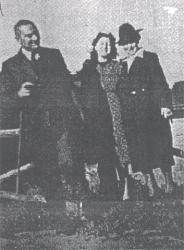
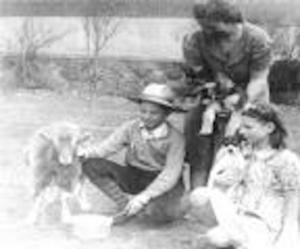
1938 photograph of Eva during the last days with her parents.

Eva Hamlet's story of survival spans several generations. Even though her beloved husband, Eddie, could never talk of his being taken to a concentration camp at the age of 13. Eva has chronicled her story of survival against the Nazis and The Third Reich in the hopes that this horrible tragedy will never be repeated.

The holocaust left her with only a few distant relatives as the remainder perished in the "Iron Furnace" of Hitler's concentration camps. All of their personal belongings were destroyed.
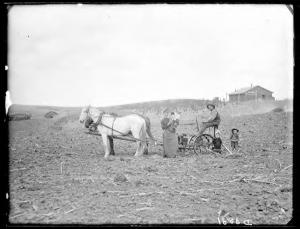
A Family of Florida Sharecroppers

Planting

The first few years of our farm life as I recall, were without electricity and plumbing. We had kerosene lamps for light, and a "Number 2" pitcher pump on our well for water. I'm not sure why they called it a "Number 2" pump, but I guess it must have been because of the size of the pipe coming out of the well. Then there was the other necessity in life, the "2 Holer" outhouse.

Our family came from a generation that was known as the "use it up, wear it out, make it do, or just do without" people! If we wore a hole in our shoes, we would put a piece of cardboard in them. As time went by, and the hole got too big, Dad would glue rubber soles on our shoes. If our clothes got holes in them, Mother would sew patches over them. If our farm plow or wagon broke down, we would fix it with hay baling wire.

Mother cooked on a wood stove, and later advanced to a five burner kerosene stove, where two of the burners were under the oven. She had a "safe cabinet," or Pie Safe, that had a screen on the doors and sides. This is where left-over food that would keep without refrigeration was kept until the next day.

Legacy of Andrew J. Riley

January 2006Dad had nightmares from his military service. Once Dad told my mother, don't move Teen (his name for her), there's a snake on the ceiling. He would also cry out orders to other soldiers in his sleep.

After the war he bought a big store in the country. The town was 4 miles West of downtown Gettysburg and called Seven Stars. He transformed part of the house into a small general store and he called it Rileys General Store. It had everything you could need from shoes, dresses, sock, undies, mens wear, shotguns, shells, nuts, bolts, and of course, food.

Easter time was a time for some of us getting colored peeps and then ducks. The peeps turned into adult chickens and so we had eggs to gather. This to me was fun. Then we even had duck eggs whose yolks were an extra dark orange. I did not notice any difference in the taste. Of course, these adult chickens also became an occasional Sunday dinner. So did the ducks, I think. I only remember the ducks swimming in any little puddle they would find after a rain.

Kites Chapter Four: Growing Up in Bethlehem, Pennsylvania

My father told me of camping out with other boys and shooting chickens with umbrella staves with a string on them so they could retrieve them. They also fished in the Saucon Creek near the area where the sewage plant is now. At that time it was farmland with only a few houses. Because he started work when he was twelve years old, there could not have been too much of this activity. This area is where the B.O.F. is located now.

The First World War had the Bethlehem Steel expanding beyond this area. The Heights, as it was known, became a slum and was later torn down after W.W.2.

We had no bathroom so all baths were taken in the kitchen. Water was heated on the stove and a large tin tub was the bathtub. Wood and coal were kept outside. The Corn Crib was the coal bin. Water was pumped from a well outside near the back porch and hauled in bucket by bucket. This was usually my job as my father worked swing shift and was gone most evenings. He worked down on The Heights and took the bus, a five-cent trip. He smoked Bull Durham tobacco and rolled his own cigarettes. I know one time he walked home to save the five cents for a sack of tobacco.

Kites Chapter Three: William Gieske's Memories of Bethlehem, Pennsylvania

Dr. Bloss lived on Broad Street near Second Avenue and had his office in the rear in a little building. I remember having to go there for my vaccination so I could go to school. At that time boys got them on their arm and girls on their legs. I guess that was so girls did not have a scar that would show.

On the way home the big treat was an ice-cream cone at Avondales out door window, the forerunner of a drive up. Small cones were five cents and a very large cone cost only ten or twelve cents. This was big money in those days. The cones were scooped out with a trowel not a dipper and the men liked to see kids get there share.

The tow path was where the mules that pulled the canal boats walked. These mules knew just how fast to go and when to stop. The Chain Dam in Glendon, Pennsylvania, was where the canal boats crossed the Lehigh River. Coming from Philadelphia they entered the lock and were raised up to the river level. The boats were pulled upstream and then cut loose to drift across to the north bank where the canal is. The mules were taken across on the suspension bridge.

Kites Chapter Two: Continuing The Childhood Memories Of William Gieske

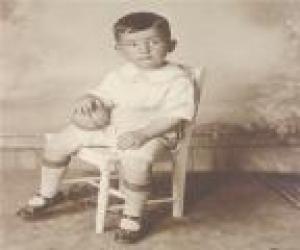
Image of William Gieske as a Child

We had a large back yard with buildings along the alley, one of which was an outhouse. My brother Neal threw a kitten down the hole one summer day and cousin Earl had the job of fishing it out, but I don't know who cleaned it up. I do remember the honey dipper coming to clean the outhouse as they were called. Now there is a job that disappeared and no one regrets its demise.

My mothers father, Franklin Zettlemoyer, was found dead in the Monacacy Creek, behind the paint mill. It was not understandable how he got there.

We were led to believe he was in the state hospital at Rittersville, Pennsylvania. That is what the nut house was called. When I started doing genealogy, I uncovered the truth. He had been injured at the iron works, this was before the Bethlehem Steel Co., and he was in Saint Luke's for a time for a head injury. He was the first patient admitted at Rittersville, Pennsylvania. He was transferred to the poor farm, or the county home for the elderly, as it was known. This was located near Schoenersville, Pennsylvania.

Kites Chapter One: The Childhood Memories Of William Gieske

Photo of Chalet Bill

I asked myself why are you writing this story of your life. I really do not have a definite answer to that question. The only justification I can think of is to give my grandchildren an idea of what life was like in the old days.

Have you ever tried to picture your parents as young people, much younger than you are now? Its difficult or impossible to get a clear picture of your mother or father as a young person let alone as a small child. If you can't picture someone you are as close to as your parents how could you ever imagine what it was like for your grandparents. Perhaps that is what I am trying to shed some light on.

Our grandchildren live a different world than we were raised in, some for the better but much of it must be improved. I believe that prior generations also had their great differences but my generation has probably seen more changes in their lives than any other generation. We lived through the great depression, WW2, Korea, Vietnam and the cold war plus living at a time of the greatest technological advances ever known.

Thelma Wenzel: A Life Dedicated to Medical Science

Photo of Thelma Wenzel

Thelma Wenzel recalls a tornado hitting St. Louis in 1896. "It was on Dolman Street," she said. "Mama knew that the tornado was upon us. She had a lamp in one arm and me, an infant at the time, in the other.

Each room we entered, the way through would be blown away as soon as we left it. We would just barely get through a room before it was gone. Mama was trying to keep me against her chest because of the vacuum being created by the tornado. She was afraid that I would smother.

I was learning long division in school. One day I was trying to reason out the way to do a particular problem. I finally got the answer, but my teacher came over and said, "Thelma Wenzel! You cheated! You must have turned to the back of the book and gotten the answer."

"Well, I had not cheated! It would never have occurred to me to do such a thing. My mother brought me up to be honorable," she said. "You weren't anything unless you were truthful and honest. That was one thing that I had to be," she concluded.

Julia Flanagan

Photograph of Julia and Edward Flanagan

Aside from not having a car, her family didn't have the luxury of running water or electricity. Lighting consisted of kerosene lamps, heat consisted of a wood-burning stove, and water was retrieved from the well. Julia did attend a one-room schoolhouse for a few years. Children from five or six different grades were mixed in together.

A typical day for Julia consisted of getting out of bed at 5:00 a.m. to water the horses and get ready for school. She would come home at from school 3:00 and help her mother prepare supper. Her family ate dinner at 5:30 and she would go to bed when the sun went down. Occasionally, she and her mother would stay up later and listen to Tom Mix or Lux Theater on a battery-operated radio. It was after high school graduation that Julia started working for the New York Telephone Company.

She worked there for six years. Her starting weekly salary amounted to $16.00 a week when she was in training and gradually increased to $18.00 per week.

Shortly after her husband got back from WWII she became pregnant. The New York Telephone Company didn’t allow her to work when she showed obvious signs of pregnancy. Unfortunately, she had to discontinue working even though she wasn’t having any problems with her pregnancy. She accepted this regulation that New York Telephone Company set, as it was the norm at that time. As a rule, during her age cohort, women were expected to stay home and raise a family as well as do all the household chores.

Pages